

 +44 3308180992
Research Article - International Research Journal of Pharmacy and Pharmacology ( 2025) Volume 13, Issue 1
Received: 09-Sep-2024, Manuscript No. irjpp-24-147629; Editor assigned: 11-Sep-2024, Pre QC No. irjpp-24-147629 (PQ); Reviewed: 25-Sep-2024, QC No. irjpp-24-147629; Revised: 08-Feb-2025, Manuscript No. irjpp-24-147629 (R); Published: 15-Feb-2025, DOI: 10.14303/2251-0176.2025.96
The present investigation is regarding the traditional medicinal plants and their uses to treat asthma disease by ethnic and indigenous community peoples of Lakhimpur district of Assam. Major ethnic and indigenous communities of Lakhimpur district are Chutia, Ahom, Mishing, Bodo, Deori, Kachari, Tea tribes and Khamti. In traditional medicines they are using valuable medicinal plants or plant parts. The traditional medicine information was collected from remote villages of Lakhimpur district through survey method during the period of November 2023 to July 2024. Thematic questionnaire was used in face to face interview. This study provides huge information about 33 valuable medicinal plant details which are widely using to cure asthma disease by ethnic and indigenous rural community peoples of Lakhimpur district of Assam. It also reflects the important part(s) of these medicinal plants, form of application and dose amount with duration to take. Traditional medicines of asthma are cheaper and lesser side effects than conventional drugs. Traditional medicines are playing the most significant role in the treatment of asthma disease in Lakhimpur district of Assam.
Asthma, Medicinal plants, Traditional medicines, Ethnic and indigenous community, Lakhimpur district
Lakhimpur has a total population of 1,042,137 as per the Census of 2011, about 91.24% population of Lakhimpur district belong to the rural backgrounds and 23.93% is the tribal peoples (Bor NL, 1940). It is a home to several indigenous and ethnic community peoples (Kanjilal UN et al., 1934). In Lakhimpur, major communities are Chutia, Ahom, Mishing, Bodo, Deori, Kachari, Tea tribes and Khamti (Kanjilal UN, 1936). These peoples are celebrating their traditional festivals as per their community schedules and living in a unity among diversity relationship (Kanjilal UN, 1938). Different communities of Lakhimpur uses diverse food habits, shelters and traditional medicines also (Kanjilal UN, 1940). They are utilizing plant resources in their precious livelihood services (Sharma UK et al., 2012).
Lakhimpur is located at the northern bank of mighty Brahmaputra river of Assam, India (N.E.). The soil condition of Lakhimpur is very fertile to grow different kinds of flora due to its nutrient rich organic soil horizons (Bora D et al., 2016). It is considered as a natural biodiversity hotspot of Assam due to its rich flora and fauna (Chakraborty R et al., 2012). Most of the ethnic and Indigenous community peoples (rural) are depending upon the flora to their traditional treatment of diseases for their survival by neglecting the modern commercially available pharmacy medicines although it may be a wrong concept. Traditional practices are following by people’s generation after generation (Phurailatpam AK et al., 2014). This study will provide huge information about the medicinal plant and plant parts which are using in traditional practices to cure the asthma or respiratory disorder by the ethnic and indigenous community peoples of Lakhimpur district, Assam, India (NE) (Choudhary RK et al., 2011).
Frequent travelling was done in various remote villages of Lakhimpur district during the period of November 2023 to July 2024 to collect the data by survey method. All relevant questions were asked to collect the accurate information regarding the medicinal plants in a pre-planned, thematic questionnaire method. Traditional healers, elder persons, sadhu baba and local medicinal experts were included for personal interview in survey. For identification purpose I used five volumes of Flora of Assam and some instances used AI overview. Verified all through Google Scholar, PubMed, Scopus, springer and ACS. Map view of the study site in Figure 1.
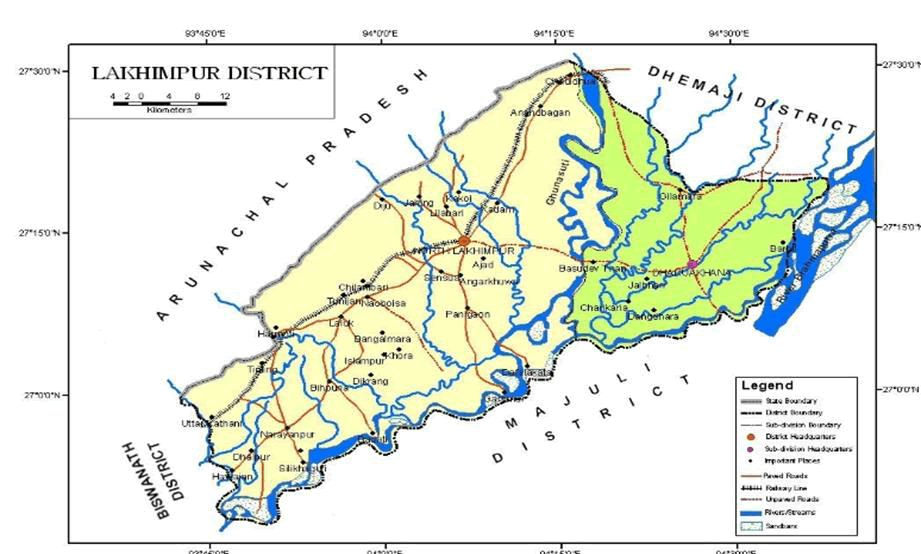
Figure 1. Map of study site (Lakhimpur district).
During this study period I had recorded medicinal plants to treat asthma disease in rural villages of Lakhimpur district of Assam, India (N.E.). Table 1 showing the findings of the survey.
| Serial no. | Scientific name | Family | Vernacular name | Type of plant | Part (s) of use | Form of application (for 25-30 days) |
| 1 | Alstonia scholaris | Apocynaceae | Satiyana | Tree | Bark and white latex | Bark decoction (100 ml) |
| 2 | Ananas comosus | Bromeliaceae | Anaros | Shrub | Fruits | Fruit decoction (200 ml) |
| 3 | Artocarpus heterophyllus | Moraceae | Kothal | Tree | Root | Root decoction (200 ml) |
| 4 | Artocarpus lacucha | Moraceae | Bohot | Tree | Bark and seeds | Bark decoction and grinded seed decoction (200 ml) |
| 5 | Bacopa monnieri (L.) | Plantaginaceae | Brahmi sak | Herb | Shoot | Shoot decoction (100 ml) |
| 6 | Bambusa vulgaris | Poaceae | Bholuka bans | Tree | Shoot | Shoot decoction (200 ml) |
| 7 | Boerhavia diffusa L. | Nyctaginaceae | Ponounuwa | Herb | Root | Root decoction (200 ml) |
| 8 | Bombax ceiba | Malvaceae | Himolu gos | Tree | Roots | Root decoction (200 ml) |
| 9 | Calamus viminalis | Arecaceae | Bet gos | Climber | Leaf | Leaf decoction (100 ml) |
| 10 | Chinese Capsicum | Solanaceae | Bhoot jalakiya | Shrub | Fruit | Fruit decoction with vegetable |
| 11 | Cassia fistula | Leguminosae | Hunaru | Tree | Fruit | Fruit decoction (100 ml) |
| 12 | Centella asiatica | Apiaceae | Manimuni | Herb | Whole plant | Whole plant decoction (100 ml) |
| 13 | Cinnamomum tamala | Lauraceae | Tejpat | Tree | Leaf | Leaf decoction (200 ml) |
| 14 | Cissus quadrangularis | Vitaceae | Harjura lota | Climber | Whole plant | Whole plant decoction (100 ml) |
| 15 | Clerodendrum infortunatum | Lamiaceae | Dhopat tita | Shrub | Leaf and bark | Leaf and bark decoction (20 ml) |
| 16 | Erythrina stricta | Papilionaceae | Modar gos | Tree | Bark | Bark decoction (200 ml) |
| 17 | Eucalyptus tereticornis | Myrtaceae | Eucalyptus | Tree | Leaf | Leaf decoction (100 ml) |
| 18 | Euphorbia hirta | Euphorbiaceae | Gakhiroti gos | Herb | Whole plant | Whole plant decoction (100 ml) |
| 19 | Ficus hispida | Moraceae | Dimoru | Tree | Bark | Bark decoction (200 ml) |
| 20 | Ficus religiosa | Moraceae | Ahot gos | Tree | Fruit | Fruit decoction (200 ml) |
| 21 | Garuga pinnata | Burseraceae | Pani omora | Herb | Leaf | Leaf decoction (100 ml) |
| 22 | Hibiscus rosa-sinensis | Malvaceae | Joba | Shrub | Bark | Bark decoction (200 ml) |
| 23 | Machilus gamblei | Lauraceae | Chum gos | Tree | Bark | Bark decoction (200 ml) |
| 24 | Melia azedarach L. | Meliaceae | Ghura neem | Tree | Root | Root decoction (100 ml) |
| 25 | Mimosa pudica | Mimosaceae | Nilajibon | Herb | Whole plant | Whole plant decoction (200 ml) |
| 26 | Ocimum gratissimum | Lamiaceae | Ram tulsi | Shrub | Leaf | Leaf decoction (200 ml) |
| 27 | Paederia foetida | Rubiaceae | Bhedai lota | Climber | Shoot | Shoot decoction (200 ml) |
| 28 | Passiflora edulis | Passifloraceae | Lota bel | Climber | Root | Root decoction(50ml) |
| 29 | Phyllanthus fraternus | Euphorbiaceae | Mati amlokhi | Herb | Whole plant | Whole plant (100 ml) |
| 30 | Prunus domestica | Rosaceae | Ahom bogori | Shrub | Fruit | Fruit decoction (50 ml) |
| 31 | Ricinus communis | Euphorbiaceae | Era gos | Shrub | Leaf | Leaf decoction (100 ml) |
| 32 | Terminalia bellirica | Combretaceae | Bhumura gos | Tree | Seeds | Seed decoction (200 ml) |
| 33 | Tinospora cordifolia | Menispermaceae | Hoguni lota | Climber | Shoot | Shoot decoction (100 ml) |
Table 1. Scientific name, family, vernacular name, plant type, part(s) use, form of application and amount of dose with days.
Total 33 valuable medicinal plant species were reported to cure asthma disease. Out of these, 14 trees, 7 shrubs ,7 herbs and 5 climber type of plant species. Moraceae family had the highest members with 4 species. Whole plant body used for medicinal purpose in case of 5 species. All these plants are very widely using to cure the asthma problems in different remote villages of Lakhimpur district. Decoction of barks, roots and leaf of plants are playing the major significant role in traditional practices. But it shows a slow recovery of patient compared to conventional drugs.
This study reveals that the ethnic and indigenous community have their own traditional medicines to cure asthma in a low cost. They are independent regarding the asthma treatment without any side effects of medicine. Some of the local healers are developing their own small plant gardens to conserve different valuable medicinal plants for community health service. Community peoples have strong faith on traditional medicines although there is no any valid scientific or phytochemical measurement of dose so it visualises the gap between the traditional medicine practice and the pharmacological research world. There is a need of proper test of therapeutic efficacy and find out the specific bio-active compound of these traditional medicines. Finally, it can be expected that novel formulation can be developing from these plants to treat asthma disease with instant recovery in the future.
No conflict of interest to be disclosed.
The author is thankful to Dr. Ratul Nath, Department of Life Sciences, Dibrugarh University to suggesting me to do this study. I am really grateful to each and every ethnic and indigenous community peoples of different villages of Lakhimpur district for their kind cooperation during the entire study.
[Crossref] [Google Scholar] [PubMed]