

 +44 3308180992
Research Article - International Research Journal of Engineering Science, Technology and Innovation ( 2025) Volume 11, Issue 2
Received: 26-Jun-2024, Manuscript No. irjesti-24-139956; Editor assigned: 28-Jun-2024, Pre QC No. irjesti-24-139956(PQ); Reviewed: 12-Jul-2024, QC No. irjesti-24-139956; Revised: 03-Mar-2025, Manuscript No. irjesti-24-139956(R); Published: 10-Mar-2025, DOI: 10.14303/2315-5663.2024.99
NATM is a design philosophy as well as a construction process. The idea is to reinforce the tunnel construction as much as possible by utilizing the strength of the surrounding earth. Put another way, the tunneling process is dictated by the ground conditions. Constant monitoring is also encouraged by the NATM ideology. The study investigates the structural behavior of concrete linings in Mumbai Metro Line-3's Sahar Road crossover, focusing on the comparison between the New Austrian Tunneling Method (NATM) and Tunnel Boring Machine (TBM) utilization. The research aims to understand the effectiveness of these methods in ensuring the integrity and stability of tunnel constructions. The research compares various load combinations at different sections and parts of the crossover. Stress resultants, including axial force, moments, and shear forces, are analyzed using STAAD Pro software to understand the concrete tunnel lining's structural behavior accurately. Additionally, Von Mises stresses are used to predict the behaviors of SCL under the complex loading. Principal minor and major resultant stresses are scrutinized. The design of the final lining in underground works through NATM (New Austrian Tunneling Method) incorporates a comprehensive approach, encompassing software analysis, conventional concrete lining principles, and the implementation of Steel Fiber Reinforced Sprayed Concrete Lining (SCL). This multi-faceted design methodology ensures the structural integrity and safety of the final lining in underground constructions.
Concrete lining, TBM, NATM, Stresses, Steel fiber reinforced sprayed concrete lining, Software analysis STAAD pro
The metro line's extensive urbanization along its course limited the amount of space available for cut-and-cover stations at several sites (Song Z et al., 2020). As a result, the station platforms were built using NATM techniques to fit the station in crowded regions (Lin W et al., 2023). Similarly, the crossovers are intended as NATM crossovers because to space restrictions and the availability of suitable stratum (Wenzheng H et al., 2019).
Three cross overs, two sidings, and twenty-six underground stations—seven of which are NATM stations (hybrid stations with NATM & cut and cover works)-make up the line (Miralimov M et al., 2021). NATM cross passage is offered in accordance with NFPA-130 (Bedi, 2022). Below is a table listing all of the stations, NATM stations, and NATM crossovers (Gope A et al., 2022) (Tables 1-3).
|
Sr. No. |
Station |
|
1 |
Cuffe Parade Station |
|
2 |
Vidhan Bhavan |
|
3 |
Church-gate |
|
4 |
Hutatma Chowk |
|
5 |
CST Metro |
|
6 |
Kalbadevi |
|
7 |
Girgaon |
|
8 |
Grant Road |
|
9 |
Mumbai Central |
|
10 |
Mahalaxmi Worli |
|
11 |
Science Museum |
|
12 |
Acharya Atre Chowk |
|
13 |
Worli |
|
14 |
Sidhivinayak |
|
15 |
Dadar |
|
16 |
Shitaladevi |
|
17 |
Dharavi |
|
18 |
BKC |
|
19 |
Vidya Nagari |
|
20 |
Santacruz |
|
21 |
CSIA- Domestic |
|
22 |
Sahar Road |
|
23 |
CSIA- International |
|
24 |
Marol Naka |
|
25 |
MIDC |
|
26 |
SEEPZ |
Table 1. All stations in Mumbai metro line-3.
|
Sr No. |
Station |
|
1 |
Hutatma Chowk |
|
2 |
Kalbadevi |
|
3 |
Girgaon |
|
4 |
Grant Road |
|
5 |
Shitaladevi |
|
6 |
Santacruz Station |
|
7 |
Marol Naka |
Table 2. NATM stations.
|
Sr No. |
Cross over location (station near cross overs) |
|
1 |
CST (North side) |
|
2 |
Acharya Atre Chowk (South Side) |
|
3 |
Sahar road (South Side) |
Table 3. NATM crossovers near stations.
Modern metropolitan areas are experiencing constant urban development, which has resulted in an urgent requirement for efficient and durable public transit systems (Zhang C et al., 2021). Underground metro systems have become essential for linking densely populated metropolitan regions and alleviating the negative effects of traffic congestion (Wu B et al., 2020). Underground construction presents a unique set of obstacles that require an appropriate combination of advanced engineering and complex design in order to realize underground metro systems (Maraveas C et al., 2014) (Figure 1).
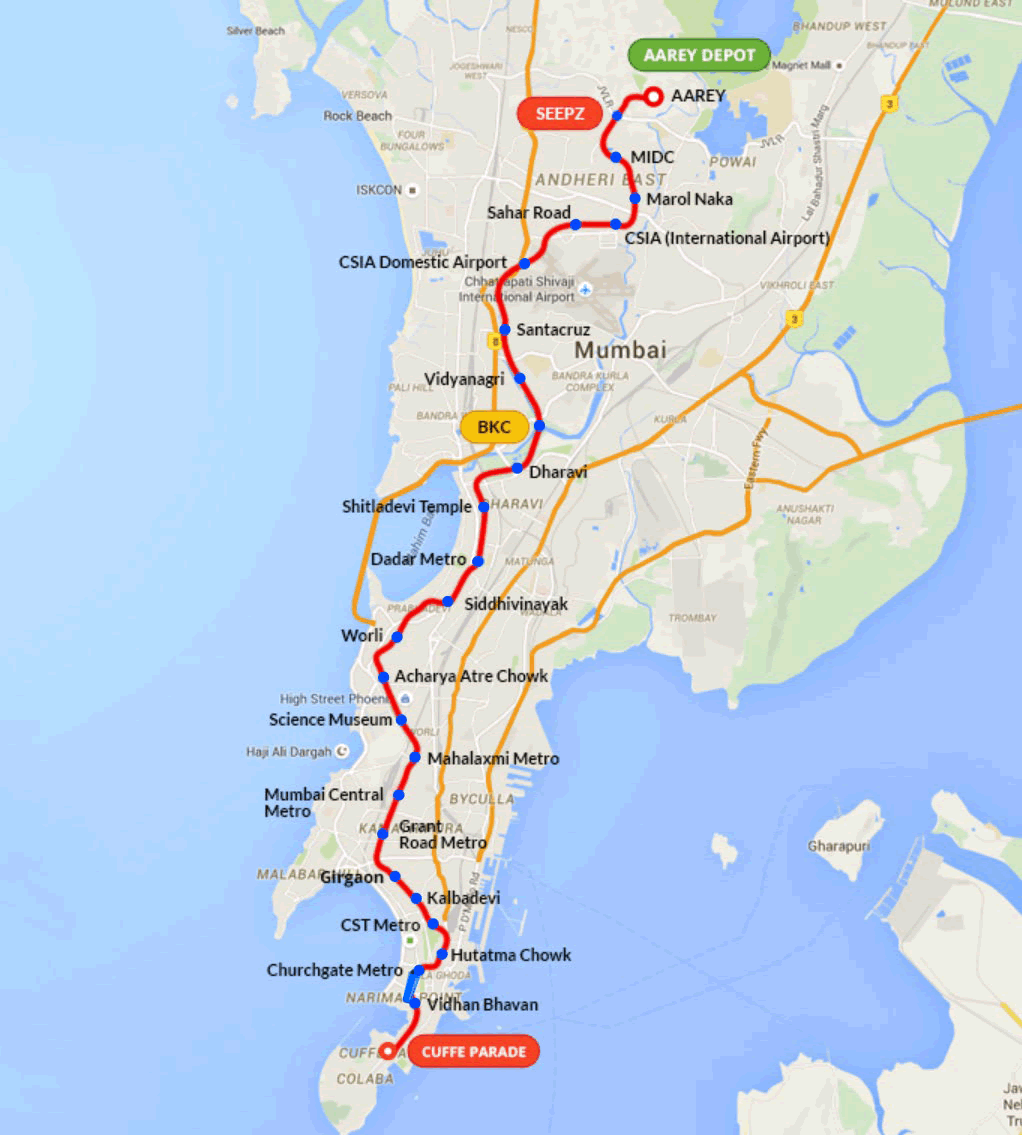
Figure 1. Map showing Mumbai metro line-3.
Single-track or multiple tracks, with or without station platforms, adits, cross tunnels, and cross overs, make up the NATM tunnel (SP 16, 1980). To ensure seamless tunneling operations with NATM technology, the design parameters must take into account the ground's geology and geotechnical characteristics, as well as a robust monitoring system and support design (IS 800, 2007). The completed tunnel profile must adhere to all SOD (Schedule of Dimensions) regulations and services (BIS I. 456, 2000).
Depending on the site's limitations and the state of the earth, NATM tunnels may be dug out with a variety of contemporary blasting techniques, such as road headers, excavators, breakers, and expanding chemical agents (Williams O, 1997). To stop the disintegration and collapsing of the loosened rock mass once the tunnel is excavated, the first tunnel support is often provided by sprayed concrete, rock bolts, lattice girders, steel sets, or fore poles, among other materials. The final lining for a tunnel must be made of precast sections, cast-in-situ concrete, sprayed concrete, or concrete reinforced with steel fiber mesh. Techniques, enhancing structural integrity, and ensuring the safety and efficiency of underground infrastructure projects.
The inception of underground metro systems marked a paradigm shift in urban mobility. These subterranean networks have not only redefined public transportation but have also necessitated an upgradation in engineering practices. The sub-surface construction of metro tunnels introduces challenges related to geotechnical conditions, soil-structure interaction, construction methodology, construction safety considerations, underscoring the need for specialized engineering solutions.
The core of the underground metro system consists of a relatively small yet highly significant component called the tunnel lining. The goal of this research is to clarify the complexities involved in creating strong tunnel linings, which are essential to the structural integrity and durability of underground metro tunnels. The tunnel lining serves as both a structural shield and a guardian tasked with the enormous responsibility of protecting against outside influences, withstanding soil pressures, and negotiating the difficulties presented by dynamic loads that are essential to the continuous functioning of metro systems. And increasing structural stability and to enhance the stability of tunnel. It helps in diverting the ground water away from the tunnel.
Tunnel lining resists forces induced due to rapid train movement, strata loads over tunnel and ground water loads, seismic loads. Therefore, designing a tunnel lining for underground metro systems requires a careful balancing act between material science, technical accuracy, and a sophisticated grasp of the dynamic forces at work. The loads considered in design of tunnel lining are elaborated further.
Objectives and scope of study
• Conduct a comprehensive comparison of different load combinations at each section and different parts of the sections along the Sahar Road cross-passage of Mumbai Metro Line-3, focusing on both the New Austrian Tunneling Method (NATM) and Tunnel Boring Machine (TBM) construction techniques.
• Utilize software analysis, particularly STAAD Pro, to analyze stress resultants (axial force, moments, shear forces) in the concrete tunnel linings to gain a precise understanding of their structural behavior.
• Evaluate the combined stresses obtained from the analysis to assess their impact on the structural integrity and performance of the concrete tunnel linings.
• Develop a design methodology for concrete tunnel linings based on the findings and considerations derived from the comparison and analysis of different construction techniques.
• Investigate the effects of shear forces and biaxial moments, along with compression, on the concrete along with compression, on the concrete tunnel linings, particularly considering the final lining of NATM as a short column.
• Employ Von Mises stresses to predict the behaviors of Steel Fiber Reinforced Sprayed Concrete Lining (SCL) under complex loading conditions, scrutinizing principal minor and major resultant stresses to assess structural performance and durability.
The scope of this study encompasses a detailed investigation into the structural behavior of concrete linings along the Sahar Road cross-passage of Mumbai Metro Line-3, focusing on the comparison between NATM and TBM construction methods. The study will evaluate different load combinations and stress resultants using advanced software tools like STAAD Pro, considering various sections and parts of the cross-passage. Additionally, the study will delve into the design of concrete tunnel linings, with particular emphasis on the implementation of Steel Fiber Reinforced Sprayed Concrete Lining (SCL) principles. The investigation will consider the unique challenges posed by the ground conditions and the final lining of NATM, treating it as a short column. The findings of the study will have implications for optimizing tunnel construction.
This section describes the research strategy, data gathering strategies, analytical tools, and validation procedures utilized to examine how the New Austrian Tunneling Method (NATM)'s structural behavior relates to the utilization of Tunnel Boring Machines (TBM). To provide complete and accurate findings, the technique incorporates advanced software analysis, conventional concrete lining principles, and rigorous testing criteria.
Research design
The research uses a mixed-method approach, combining quantitative analysis through simulation models and qualitative insights from case studies and field observations. This combination allows for a thorough understanding of the structural behaviors of tunnels constructed using the New Austrian Tunneling Method (NATM) and Tunnel Boring Machine (TBM) under various conditions, enabling a robust comparative analysis.
Data collection methods
Literature review: Collection of secondary data from academic journals, industry reports, and technical standards to establish a theoretical foundation and identify existing knowledge gaps.
Field data: Gathering primary data from ongoing and completed tunnel projects using NATM and TBM method. This includes observational data, construction records, and monitoring reports.
Analysis and design methodology
STAAD pro: STAAD pro is used for structural analysis and design of tunnel linings. The software helps in determining key stress resultants such as axial force, moments, and shear forces. By using STAAD Pro, the structural behavior of tunnel sections under various loading conditions can be accurately analyzed. This includes assessing the performance of different lining materials and configurations (Figure 2).

Figure 2. Assessing the performance of different lining materials and configurations.
Simulation models: Simulation models are developed to predict the structural behavior of tunnels under a range of loading and ground conditions. These models incorporate detailed geometries and material properties to reflect real-world scenarios. The simulation models help in understanding how tunnels respond to different stress conditions, including dead loads, live loads, and seismic loads. This predictive analysis is crucial for designing safe and efficient tunnel structures.
Design standards: IS-456:2000: This provides guidelines for the design and construction of reinforced concrete structures. It is applied specifically for designing and analyzing Cast in Place (CIP) concrete linings in tunnel construction.
Case studies
Case study selection: Selection of relevant tunnel projects utilizing NATM and TBM. The selection criteria include the complexity of geological conditions, scale of the project, and availability of detailed construction and monitoring data.
Field observations: Data collection to observe the implementation of NATM and TBM, focusing on construction techniques, support systems, and monitoring practices.
Data documentation: Systematic documentation of case study findings, including photographs, project reports, and interview notes from project engineers and managers.
Modelling methods
Model creation: Final Tunnel Lining Geometry Creation of Mumbai Metro Line (MML-3), Sahar road crossover of all possible cross-sections of NATM and TBM. The models incorporate various ground conditions, tunnel geometries, and support systems.
Supports: While analysis of concrete linings using STAAD Pro, the actual supports acting on the lining are in the radial direction. However, STAAD Pro does not support the direct application of radial springs. To address this limitation, the radial spring forces are resolved into horizontal and vertical pressure components. This approach allows for an accurate representation of the radial supports within the constraints of the software, ensuring that the analysis reflects the true structural behavior of the concrete lining.
Load applications: The methodology for load application on each section geometry of the Sahar Road cross-passage in Mumbai Metro Line-3 involves the primary loads that are applied to each defined section geometry. These primary loads include the Dead Load
Hydrostatic Pressure, Earth Pressure, and Surcharge loads. Various load combinations are developed, such as in load case 1 & 3 dead load, hydrostatic pressure, earth pressure and surcharge. In load case 2, 4 & 5 dead load, hydrostatic pressure and earth pressure. In load case 6 dead load, hydrostatic pressure, earth pressure and surcharge.
Stress analysis: Analysis of principal minor and major resultant stresses.
Geometry and lining type
The different sections of the Mumbai Metro Line-3 (MML3), NATM crossover at Sahar road station that is used in for this research. Below described are the plan, cross-sections and 3D- views of crossover tunnel. On each of the 8 section axial force, bending moment, and shear force, stresses is obtained by software STAAD pro (Figures 3-6 & Table 4).
|
Parameters (IN M) |
Section A |
Section B |
Section C, D |
Section E, H |
Section F |
Section G |
|
Tunnel diameter |
8.007 |
11.524 |
13.857 |
15.625 |
8.01 |
17.215 |
|
Tunnel height |
6.085 |
6.972 |
7.545 |
8.062 |
5.472 |
8.581 |
|
Lining thickness |
0.3 |
0.35 |
0.4 |
0.3 |
0.3 |
0.3 |
|
Overburden height |
23.64 |
22.703 |
22.08 |
21.513 |
23.624 |
20.994 |
Table 4. Geometry details.
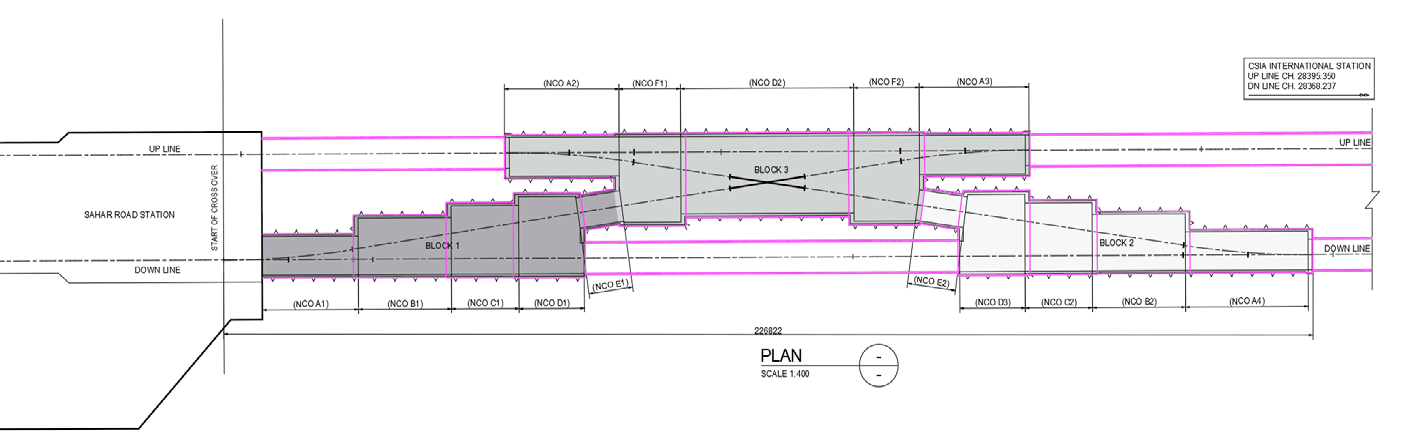
Figure 3. Plan view of crossover tunnel.
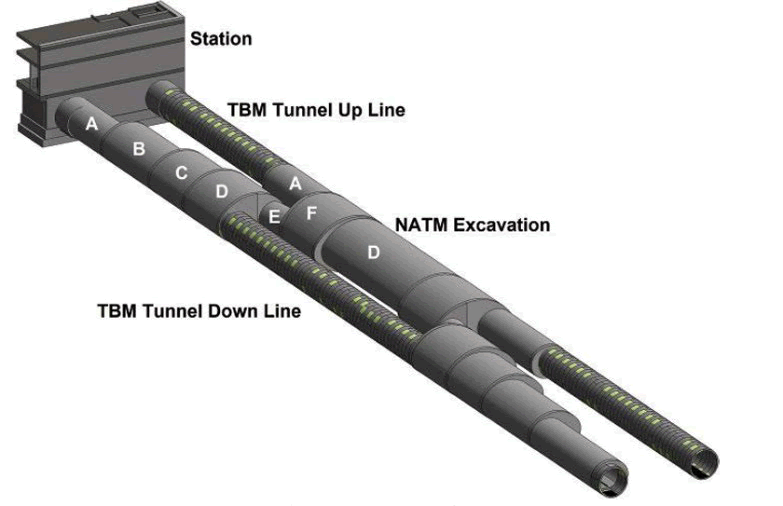
Figure 4. 3D-view of crossover.
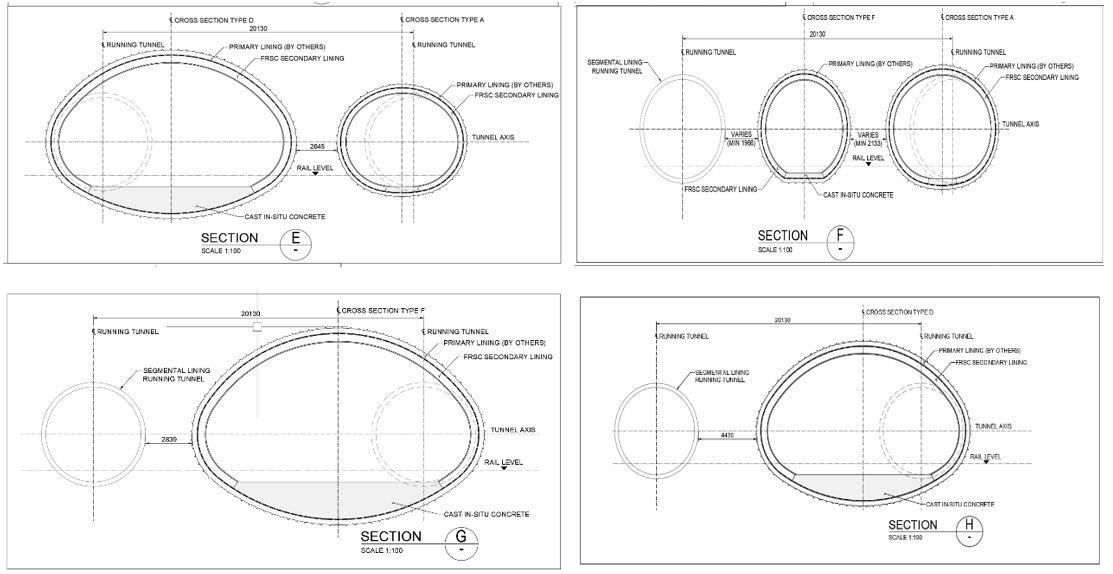
Figure 5. Cross section of all sections of tunnel lining.
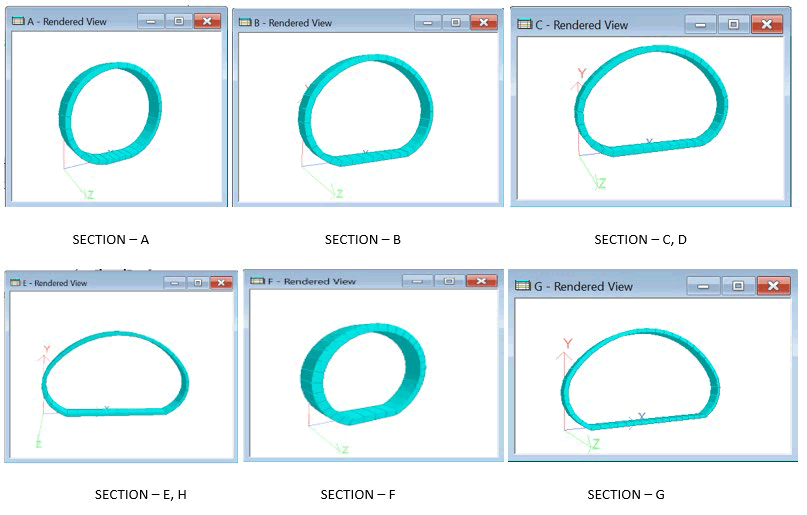
Figure 6. STAAD rendered view of crossover.
Loads analysis
The following are the primary loads that must be considered in the analysis and design of tunnel linings:
Dead load: The dead load refers to the permanent static load exerted by the weight of the tunnel structure itself.
Earth pressure: Earth pressure is the load exerted by the earth surrounding the tunnel. It includes both the vertical and horizontal pressures due to the weight of the soil or rock.
Hydrostatic pressure: Hydrostatic pressure is the hydrostatic pressure exerted by groundwater surrounding the tunnel. This pressure varies depending on the depth of the tunnel and the groundwater level.
Surcharge: Surcharge refers to additional loads imposed on the ground surface above the tunnel. This can include loads from buildings, vehicles, and other structures.
Subgrade reaction: Subgrade reaction represents the reactive pressure exerted by the ground beneath the tunnel lining. It is essential for considering the support provided by the soil or rock to the tunnel structure (Figures 7-9).
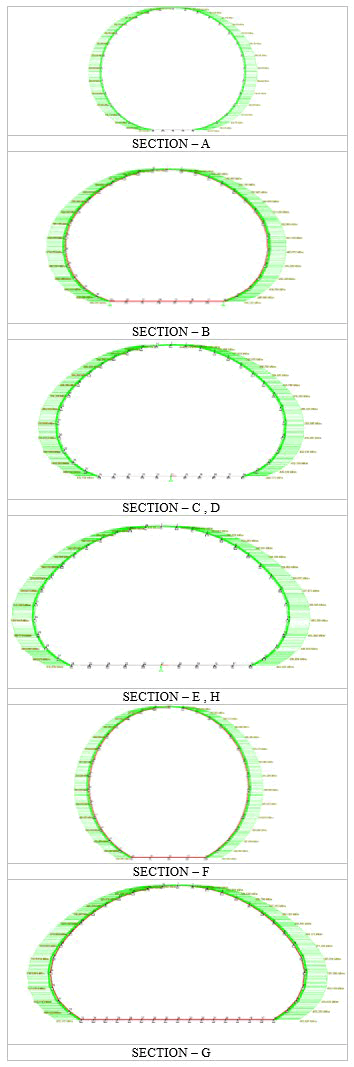
Figure 7. Earth pressure acting on different crossover section.
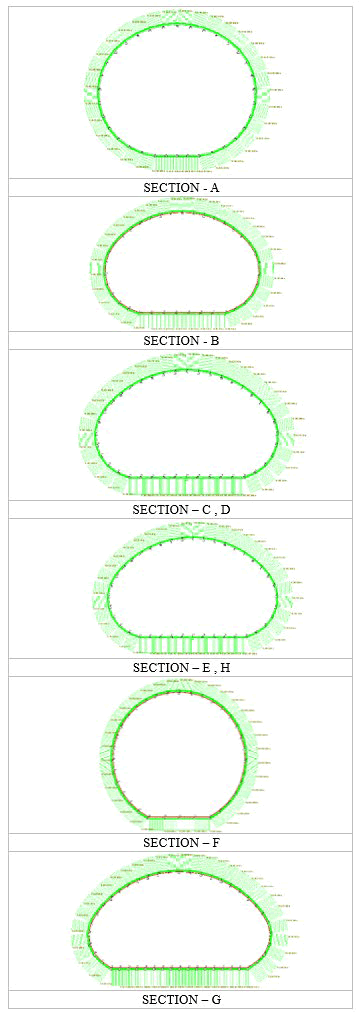
Figure 8. Hydrostatic pressure acting on different crossover sections.
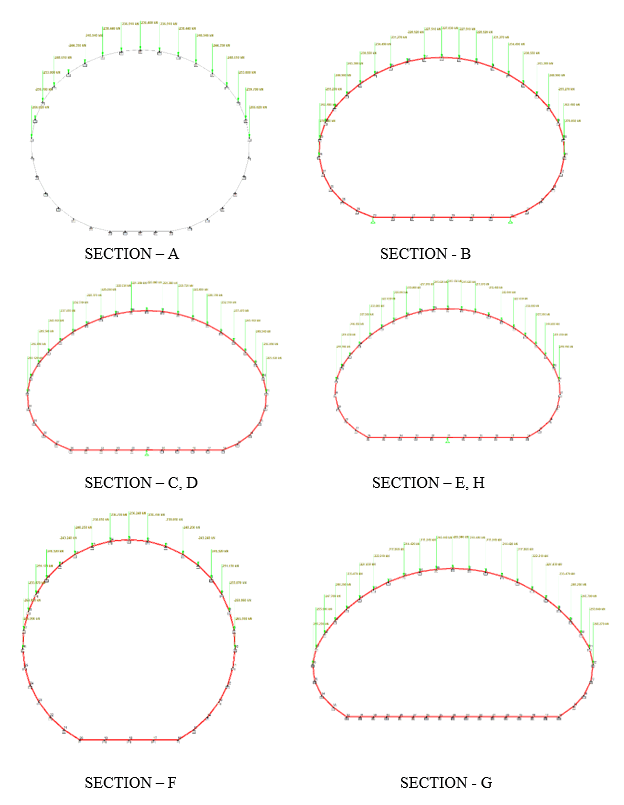
Figure 9. Hydrostatic pressure acting on different crossover section.
When performing load analysis for tunnel linings, several factors need to be considered:
Load combinations: Different loads can act simultaneously on the tunnel lining, and their combined effects need to be evaluated.
Load distribution: The distribution of loads along the tunnel length and circumference can vary, impacting the stress and deformation patterns.
Material properties: The properties of the tunnel lining materials, such as concrete and reinforcement, affect how loads are resisted.
Ground conditions: Variations in soil or rock properties around the tunnel influence the magnitude and distribution of loads (Table 5 & Figures 10-12).
|
Load case (in kN/m) |
Section A |
Section B |
Section C, D |
Section E, H |
Section F |
Section G |
|
|
1. Dead load |
10 |
10 |
10 |
10 |
10 |
10 |
|
|
2. Hydrostatic pressure |
10 |
10 |
10 |
10 |
10 |
10 |
|
|
3. Ground pressure |
PMIN |
354.6 |
340.545 |
331.2 |
322.695 |
354.36 |
314.91 |
|
PMAX |
457.605 |
464.655 |
469.14 |
477.705 |
457.365 |
485.745 |
|
|
4. Surcharge |
20 |
20 |
20 |
20 |
20 |
20 |
|
Table 5. Hydrostatic pressure acting on different crossover section.
Loads analysis of TBM
•Dead load
•Hydrostatic pressure
•Earth pressure
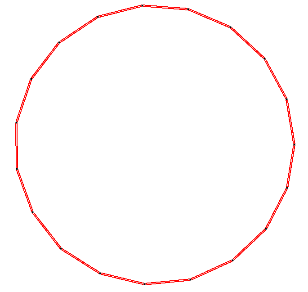
Figure 10. Dead load acting on TBM.
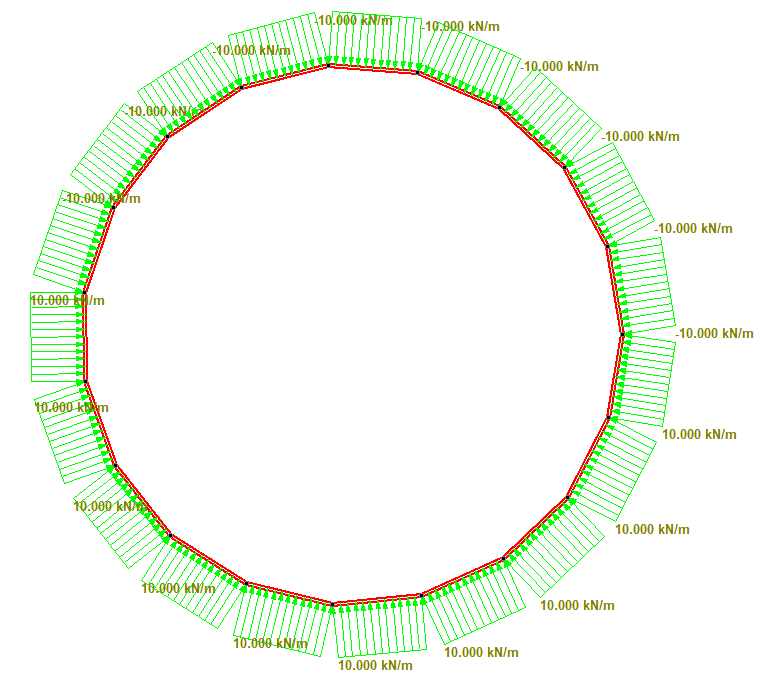
Figure 11. Hydrostatic pressure acting on TBM.
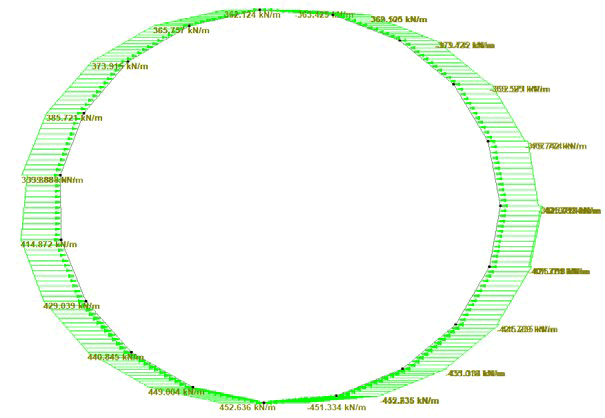
Figure 12. Earth pressure acting on TBM.
Structural behavior of NATM
Axial force distribution: The below table represent the Axial Force Distribution (in kN) acting on various structural components (Top heading, Bottom, and Side Wall (Left)) under three different loading combinations (Combination 1, Combination 2, Combination 3) across different sections (A, B, C/D, E/H, F, G) of the tunnel lining, The axial forces in various sections of the concrete tunnel lining constructed using the New Austrian Tunneling Method (NATM) were analyzed under three different load combinations (Table 6,7 & Figure 13):
Combination 1: Dead load+Hydrostatic pressure+Earth pressure+Surcharge
Combination 2: Dead load+Earth pressure
Combination 3: Dead load+Hydrostatic pressure+Earth pressure+Surcharge
|
SR. NO. |
Combination |
Load cases |
|
1 |
1–3 |
Dead load+Hydrostatic pressure+Earth pressure+Surcharge |
|
2 |
2–4–5 |
Dead load+Hydrostatic pressure+Earth pressure |
|
3 |
6 |
Dead load+Hydrostatic pressure+Earth pressure+Surcharge |
Table 6. Load combination.
|
|
Components |
Axial force (in kN) |
||
|
Combination 1 |
Combination 2 |
Combination 3 |
||
|
SECTION-A |
Top heading |
2418.171 |
2153.106 |
1714.643 |
|
Bottom |
3151.616 |
3093.577 |
2248.39 |
|
|
Side wall (left) |
2817.448 |
2794.914 |
2011.39 |
|
|
SECTION-B |
Top heading |
3081.708 |
3079.989 |
2201.138 |
|
Bottom |
3286.081 |
2934.967 |
2330.481 |
|
|
Side wall (left) |
861.914 |
768.382 |
611.199 |
|
|
SECTION-C,D |
Top heading |
3427.43 |
3167.215 |
2435.773 |
|
Bottom |
3550.415 |
3546.82 |
2535.84 |
|
|
Side wall (left) |
3213.26 |
3208.954 |
2292.315 |
|
|
SECTION-E,H |
Top heading |
4034.882 |
3827.749 |
2872.196 |
|
Bottom |
3802.249 |
3797.463 |
2715.664 |
|
|
Side wall (left) |
3159.218 |
3150.239 |
2256.156 |
|
|
SECTION-F |
Top heading |
2173.26 |
1861 |
1537.459 |
|
Bottom |
2509.785 |
2452.911 |
1789.995 |
|
|
Side wall (left) |
2134.592 |
2115.829 |
1523.815 |
|
|
SECTION-G |
Top heading |
4315.817 |
3994.769 |
3067.438 |
|
Bottom |
4638.962 |
4632.712 |
3313.246 |
|
|
Side wall (left) |
534.219 |
433.526 |
348.824 |
|
Table 7. Axial force distribution on NATM tunnel lining.
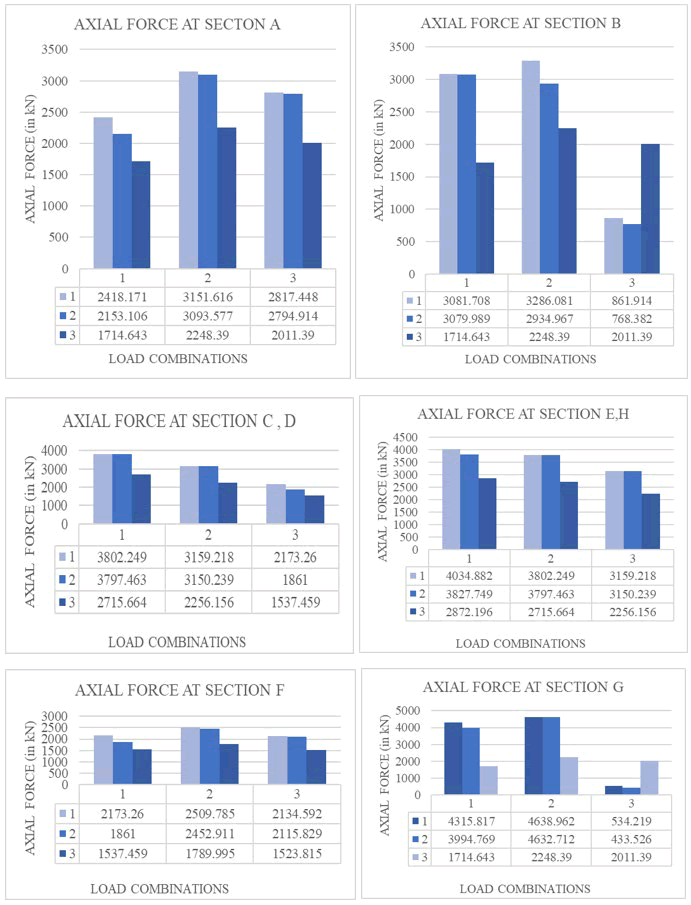
Figure 13. Graphical representation of axial force and load combinations at all sections of NATM tunnel lining.
Bending moment distribution
The below table represent the bending moment distribution (in kN.m) acting on various structural components (top heading, bottom, and side wall (left)) under three different loading combinations (combination 1, combination 2, combination 3) across different sections (A, B, C/D, E/H, F, G) of the tunnel lining (Table 8 & Figure 14):
|
|
Components |
Moment (in kN.m) |
||
|
Combination 1 |
Combination 2 |
Combination 3 |
||
|
SECTION-A |
Top heading |
354.193 |
350.183 |
252.804 |
|
Bottom |
56.317 |
45.428 |
39.708 |
|
|
Side wall (left) |
95.162 |
94.487 |
67.94 |
|
|
SECTION-B |
Top heading |
696.173 |
694.314 |
497.178 |
|
Bottom |
196.523 |
201.852 |
140.628 |
|
|
Side wall (left) |
197.121 |
168.565 |
139.441 |
|
|
SECTION-C,D |
Top heading |
608.366 |
605.103 |
434.392 |
|
Bottom |
256.367 |
261.151 |
183.347 |
|
|
Side wall (left) |
332.459 |
322.774 |
231.014 |
|
|
SECTION-E,H |
Top heading |
587.014 |
585.55 |
419.226 |
|
Bottom |
43.668 |
43.494 |
31.183 |
|
|
Side wall (left) |
169.555 |
178.219 |
121.523 |
|
|
SECTION-F |
Top heading |
361.261 |
352.302 |
257.617 |
|
Bottom |
140.993 |
125.905 |
99.991 |
|
|
Side wall (left) |
26.48 |
17.901 |
18.506 |
|
|
SECTION-G |
Top heading |
578.074 |
575.356 |
412.78 |
|
Bottom |
59.588 |
57.727 |
42.474 |
|
|
Side wall (left) |
37.348 |
600.289 |
425.984 |
|
Table 8. Bending moment distribution on NATM tunnel lining.
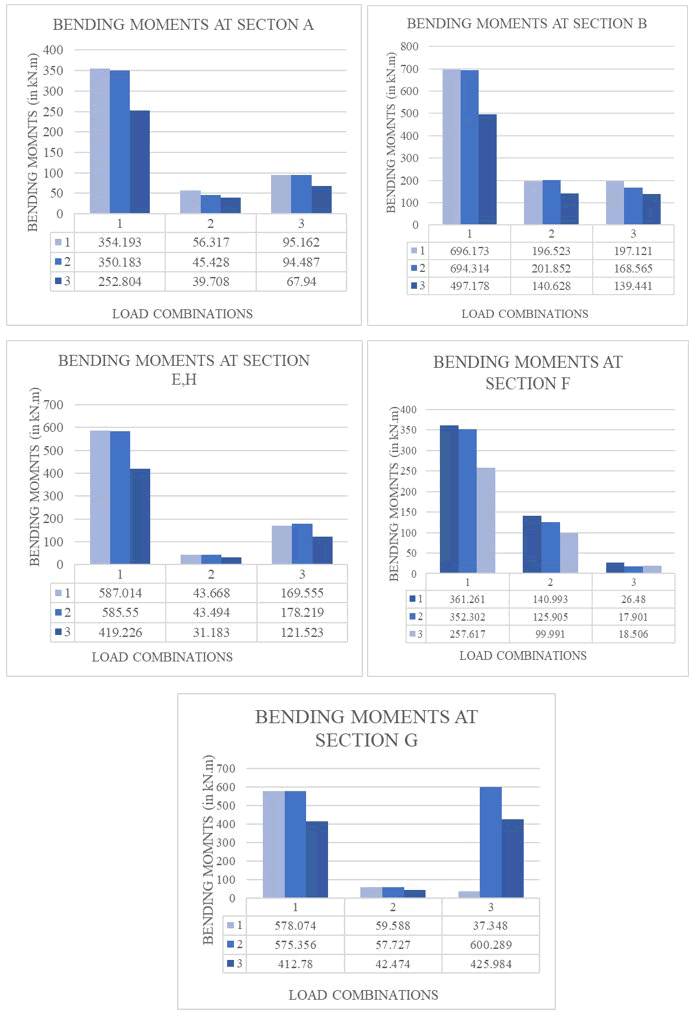
Figure 14. Graphical representation of bending moments and load combinations at all sections of NATM tunnel lining.
Shear force distribution
The data provides insights into the shear forces (in kN) acting on various structural components (top heading, bottom, and side wall (left)) under three different loading combinations (combination 1, combination 2, combination 3) across different sections (A, B, C/D, E/H, F, G) of a structure. Here's an interpretation of the data with structural reasoning (Table 9 & Figure 15):
|
|
Components |
Shear (in kN) |
||
|
Combination1 |
Combination 2 |
Combination 3 |
||
|
SECTION-A |
Top heading |
305.623 |
301.423 |
218.102 |
|
Bottom |
94.333 |
95.191 |
67.422 |
|
|
Side wall (left) |
22.21 |
16.646 |
15.599 |
|
|
SECTION-B |
Top heading |
190.401 |
190.458 |
136.004 |
|
Bottom |
129.889 |
127.406 |
92.659 |
|
|
Side wall (left) |
504.89 |
506.354 |
360.706 |
|
|
SECTION-C,D |
Top heading |
388.075 |
385.147 |
277.057 |
|
Bottom |
45.162 |
50.055 |
32.492 |
|
|
Side wall (left) |
893.587 |
836.096 |
599.949 |
|
|
SECTION-E,H |
Top heading |
519.732 |
518.444 |
371.176 |
|
Bottom |
369.895 |
371.906 |
264.307 |
|
|
Side wall (left) |
1168.792 |
1219.413 |
837.262 |
|
|
SECTION-F |
Top heading |
282.621 |
279.924 |
201.743 |
|
Bottom |
153.822 |
134.102 |
108.934 |
|
|
Side wall (left) |
367.693 |
415.937 |
264.935 |
|
|
SECTION-G |
Top heading |
510.032 |
507.631 |
364.194 |
|
Bottom |
360.214 |
365.262 |
257.536 |
|
|
Side wall (left) |
66.39 |
224.966 |
158.471 |
|
Table 9. Shear force distribution on NATM tunnel lining.
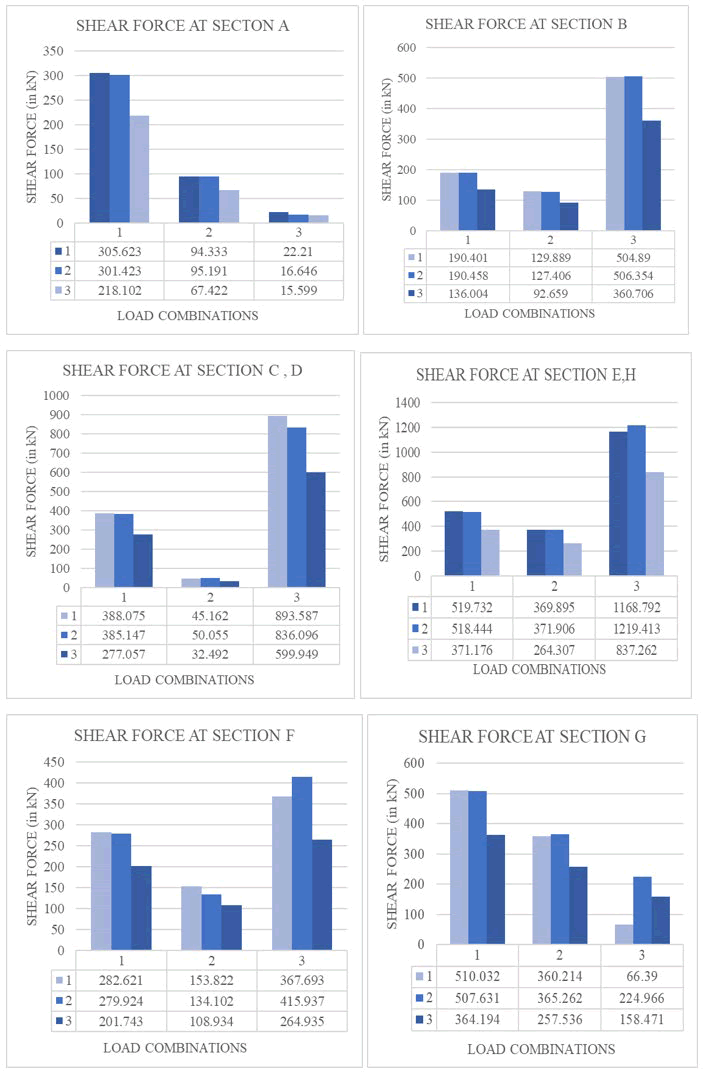
Figure 15. Graphical representation of bending moments and load combinations at all sections of NATM tunnel lining.
Combined stresses
The data provides the combined stresses acting on various structural components (top heading, bottom, and side wall (left)) across different sections (A, B, C/D, E/H, F, G) of a structure. Here's an interpretation of the data with structural reasoning (Table 10).
| Lining thickness MM | Components | Axial stresses σAxial | Bending stresses σBending | Combined stresses | Combined stresses | ||
| P/A | M/Z | σMAX=σAxial+σBending | σMIN=σAxial-σBending | ||||
| SECTION-A | 300 | Top heading | PMAX | 8.061 | 23.613 | 31.673 | -15.552 |
| PMIN | 5.715 | 23.613 | 29.328 | -17.897 | |||
| Bottom | PMAX | 10.505 | 23.613 | 34.118 | -13.107 | ||
| PMIN | 7.495 | 23.613 | 31.108 | -16.118 | |||
| Side wall (left) | PMAX | 10.272 | 23.613 | 33.885 | -13.341 | ||
| PMIN | 6.705 | 23.613 | 30.318 | -16.908 | |||
| SECTION-B | 350 | Top heading | PMAX | 10.272 | 23.613 | 33.885 | -13.341 |
| PMIN | 7.337 | 23.613 | 30.95 | -16.276 | |||
| Bottom | PMAX | 10.954 | 23.613 | 34.566 | -12.659 | ||
| PMIN | 7.768 | 23.613 | 31.381 | -15.845 | |||
| Side wall (left) | PMAX | 2.873 | 23.613 | 26.486 | -20.74 | ||
| PMIN | 2.037 | 23.613 | 25.65 | -21.576 | |||
| SECTION-C,D | 400 | Top heading | PMAX | 11.425 | 23.613 | 35.038 | -12.188 |
| PMIN | 8.119 | 23.613 | 31.732 | -15.494 | |||
| Bottom | PMAX | 11.835 | 23.613 | 35.448 | -11.778 | ||
| PMIN | 8.453 | 23.613 | 32.066 | -15.16 | |||
| Side wall (left) | PMAX | 10.711 | 23.613 | 34.324 | -12.902 | ||
| PMIN | 7.641 | 23.613 | 31.254 | -15.972 | |||
| SECTION-E,H | 300 | Top heading | PMAX | 13.45 | 23.613 | 37.062 | -10.163 |
| PMIN | 9.574 | 23.613 | 33.187 | -14.039 | |||
| Bottom | PMAX | 12.674 | 23.613 | 36.287 | -10.939 | ||
| PMIN | 9.052 | 23.613 | 32.665 | -14.561 | |||
| Side wall (left) | PMAX | 10.531 | 23.613 | 34.144 | -13.082 | ||
| PMIN | 7.521 | 23.613 | 31.133 | -16.092 | |||
| SECTION-F | 300 | Top heading | PMAX | 7.244 | 23.613 | 30.857 | -16.369 |
| PMIN | 5.125 | 23.613 | 28.738 | -18.488 | |||
| Bottom | PMAX | 8.366 | 23.613 | 31.979 | -15.247 | ||
| PMIN | 5.967 | 23.613 | 29.58 | -17.646 | |||
| Side wall (left) | PMAX | 7.115 | 23.613 | 30.728 | -16.498 | ||
| PMIN | 5.079 | 23.613 | 28.692 | -18.533 | |||
| SECTION-G | 300 | Top heading | PMAX | 14.386 | 23.613 | 37.999 | -9.227 |
| PMIN | 10.225 | 23.613 | 33.838 | -13.388 | |||
| Bottom | PMAX | 15.463 | 23.613 | 39.076 | -8.15 | ||
| PMIN | 11.044 | 23.613 | 34.657 | -12.569 | |||
| Side wall (left) | PMAX | 1.781 | 23.613 | 25.394 | -21.832 | ||
| PMIN | 1.163 | 23.613 | 24.776 | -22.45 |
Table 10. Combined stress distribution on NATM tunnel lining.
Principal stresses
The data provides the principal stresses combined with σmax acting on various structural components (top heading, bottom, and side wall (left)) across different sections (A, B, C/D, E/H, F, G) of a structure. Here's an interpretation of the data with structural reasoning (Table 11).
| Lining thickness mm | Components | Max principal stresses | Min principal stresses | Max shear stresses | ||
| σmax=σx1/2+((σx1/2)2+τ2)1/2 | σmin=σx1/2-((σx1/2)2+τ2)1/2 | τmax=(σmax-σmin)/2 | ||||
| SECTION-A | 300 | Top heading | PMAX | 31.71 | -0.03 | 15.87 |
| PMIN | 22.59 | -0.02 | 11.31 | |||
| Bottom | PMAX | 14.27 | -0.01 | 7.14 | ||
| PMIN | 10.15 | 0 | 5.08 | |||
| Side wall (left) | PMAX | 16.62 | 0 | 8.31 | ||
| PMIN | 11.23 | 0 | 5.62 | |||
| SECTION-B | 350 | Top heading | PMAX | 56.69 | -0.01 | 28.35 |
| PMIN | 40.49 | -0.01 | 20.25 | |||
| Bottom | PMAX | 24.06 | -0.01 | 12.04 | ||
| PMIN | 17.15 | -0.01 | 8.58 | |||
| Side wall (left) | PMAX | 16.19 | -0.17 | 8.18 | ||
| PMIN | 11.46 | -0.13 | 5.79 | |||
| SECTION-C,D | 400 | Top heading | PMAX | 52.01 | -0.03 | 26.02 |
| PMIN | 37.1 | -0.02 | 18.56 | |||
| Bottom | PMAX | 28.93 | 0 | 14.46 | ||
| PMIN | 20.68 | 0 | 10.34 | |||
| Side wall (left) | PMAX | 33.14 | -0.27 | 16.71 | ||
| PMIN | 23.21 | -0.17 | 11.69 | |||
| SECTION-E,H | 300 | Top heading | PMAX | 52.64 | -0.06 | 26.35 |
| PMIN | 37.56 | -0.04 | 18.8 | |||
| Bottom | PMAX | 15.68 | -0.1 | 7.89 | ||
| PMIN | 11.2 | -0.07 | 5.63 | |||
| Side wall (left) | PMAX | 22.51 | -0.67 | 11.59 | ||
| PMIN | 16.11 | -0.48 | 8.29 | |||
| SECTION-F | 300 | Top heading | PMAX | 31.36 | -0.03 | 15.69 |
| PMIN | 22.32 | -0.02 | 11.17 | |||
| Bottom | PMAX | 17.78 | -0.01 | 8.9 | ||
| PMIN | 12.64 | -0.01 | 6.33 | |||
| Side wall (left) | PMAX | 9.05 | -0.17 | 4.61 | ||
| PMIN | 6.43 | -0.12 | 3.28 | |||
| SECTION-G | 300 | Top heading | PMAX | 52.98 | -0.05 | 26.52 |
| PMIN | 37.78 | -0.04 | 18.91 | |||
| Bottom | PMAX | 19.51 | -0.07 | 9.79 | ||
| PMIN | 13.93 | -0.05 | 6.99 | |||
| Side wall (left) | PMAX | 41.81 | -0.01 | 20.91 | ||
| PMIN | 29.56 | 0 | 14.78 |
Table 11. Principal maximum stress distribution on NATM tunnel lining.
Structural behavior of TBM
The data provides the principal stresses combined with σmin acting on various structural Scomponents (top heading, bottom, and side wall (left)) across different sections (A, B, C/D, E/H, F, G) of a structure. Here's an interpretation of the data with structural reasoning (Table 12).
|
|
Lining thickness MM |
Components |
|
Max principal stresses |
Min principal stresses |
Max shear stresses |
|
σmax=σx2/2+((σx2/2)2+τ2)1/2 |
σmin=σx2/2-((σx2/2)2+τ2)1/2 |
τmax=(σmax-σmin)/2 |
||||
|
SECTION-A |
300 |
Top heading |
PMAX |
0.07 |
-15.62 |
7.84 |
|
PMIN |
0.05 |
-11.19 |
5.62 |
|||
|
Bottom |
PMAX |
6.77 |
-0.01 |
3.39 |
||
|
PMIN |
4.86 |
-0.01 |
2.43 |
|||
|
Side wall (left) |
PMAX |
3.93 |
0 |
1.97 |
||
|
PMIN |
2.18 |
0 |
1.09 |
|||
|
SECTION-B |
350 |
Top heading |
PMAX |
0.01 |
-36.15 |
18.08 |
|
PMIN |
0.01 |
-25.82 |
12.91 |
|||
|
Bottom |
PMAX |
0.08 |
-2.23 |
1.16 |
||
|
PMIN |
0.06 |
-1.66 |
0.86 |
|||
|
Side wall (left) |
PMAX |
0.27 |
-10.54 |
5.4 |
||
|
PMIN |
0.19 |
-7.45 |
3.82 |
|||
|
SECTION-C,D |
400 |
Top heading |
PMAX |
0.06 |
-29.19 |
14.62 |
|
PMIN |
0.04 |
-20.88 |
10.46 |
|||
|
Bottom |
PMAX |
0 |
-5.26 |
2.63 |
||
|
PMIN |
0 |
-3.77 |
1.89 |
|||
|
Side wall (left) |
PMAX |
0.73 |
-12.18 |
6.45 |
||
|
PMIN |
0.49 |
-8.24 |
4.37 |
|||
|
SECTION-E,H |
300 |
Top heading |
PMAX |
0.12 |
-25.8 |
12.96 |
|
PMIN |
0.08 |
-18.46 |
9.27 |
|||
|
Bottom |
PMAX |
9.92 |
-0.15 |
5.03 |
||
|
PMIN |
7.08 |
-0.11 |
3.6 |
|||
|
Side wall (left) |
PMAX |
3.53 |
-4.3 |
3.92 |
||
|
PMIN |
2.52 |
-3.1 |
2.81 |
|||
|
SECTION-F |
300 |
Top heading |
PMAX |
0.05 |
-16.89 |
8.47 |
|
PMIN |
0.04 |
-12.09 |
6.06 |
|||
|
Bottom |
PMAX |
0.21 |
-1.24 |
0.73 |
||
|
PMIN |
0.15 |
-0.85 |
0.5 |
|||
|
Side wall (left) |
PMAX |
5.62 |
-0.27 |
2.94 |
||
|
PMIN |
4.04 |
-0.19 |
2.12 |
|||
|
SECTION-G |
300 |
Top heading |
PMAX |
0.12 |
-24.27 |
12.2 |
|
PMIN |
0.09 |
-17.38 |
8.73 |
|||
|
Bottom |
PMAX |
11.61 |
-0.12 |
5.87 |
||
|
PMIN |
8.3 |
-0.09 |
4.2 |
|||
|
Side wall (left) |
PMAX |
0.01 |
-38.25 |
19.13 |
||
|
PMIN |
0 |
-27.24 |
13.62 |
Table 12. Principal minimum stress distribution on NATM tunnel lining.
The below table represent the axial force distribution, bending moments and shear force acting on various structural components of the tunnel lining of Tunnel Boring Machine (TBM) (Table 13).
|
|
Factored loads |
Moment |
Shear |
|
PU (KN) |
MU (KN.M) |
VU (KN) |
|
|
Max |
1383.486 |
98.466 |
394.3 |
|
Min |
3.502 |
77.89 |
387.37 |
Table 13. Axial force, bending moment, shear force on TBM.
Axial force distribution
The factored axial loads (PU) represent the maximum and minimum forces exerted along the axis of a structural member, such as a column or beam, in the given scenario. The maximum axial load recorded is 1383.486 kN, indicating the highest compressive force the structure needs to withstand. This substantial load suggests that the structure is designed to support heavy weights or significant vertical forces. Conversely, the minimum axial load is 3.502 kN, which could represent a minimal force scenario, possibly under lighter loading conditions or during specific phases of the load distribution (Figure 16).
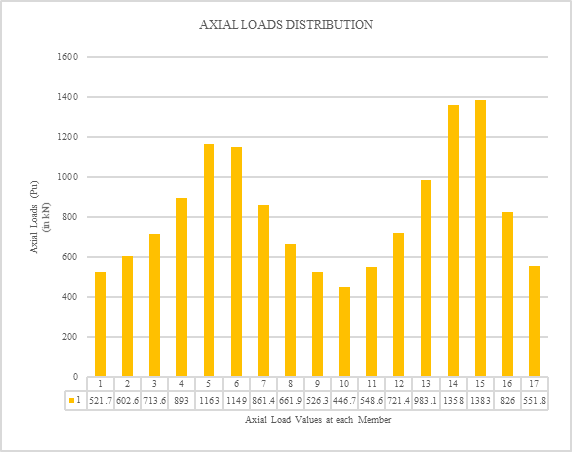
Figure 16. Graphical representation of axial force at all members of TBM tunnel lining.
Bending moment distribution
The factored bending moments (MU) indicate the moments at which the structure bends due to applied loads. The maximum bending moment recorded is 98.466 kN.m, which is the highest torque the structure needs to resist. This value is critical for understanding the flexural strength required in the design of the structural members. The minimum bending moment is 77.89 kN.m, which still indicates a significant amount of bending force but is less than the maximum. These values suggest that the structure experiences considerable bending forces, necessitating robust design measures to prevent failure (Figure 17).
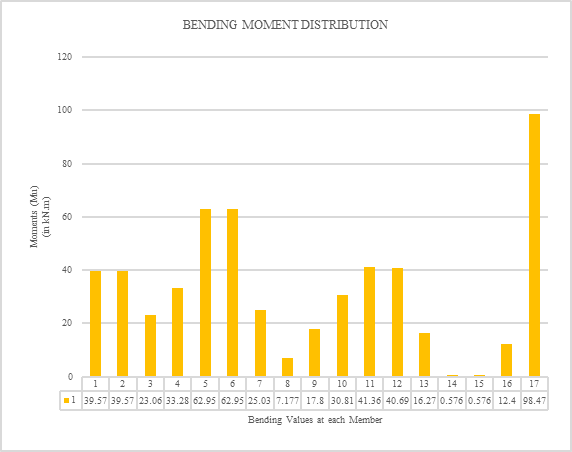
Figure 17. Graphical representation of bending moments at all members of TBM tunnel lining.
Shear force distribution
The factored shear forces (VU) are the maximum and minimum lateral forces acting perpendicular to the axis of the structural member. The maximum shear force recorded is 394.3 kN, indicating the peak shear stress the structure must endure. This value is essential for the design of elements to ensure they can handle the maximum shear without failing. The minimum shear force is 387.37 kN, which, while slightly lower, still represents a significant force. These values suggest that the structure is subjected to substantial lateral forces, and appropriate design considerations must be taken to ensure stability and integrity against shearing (Figure 18).
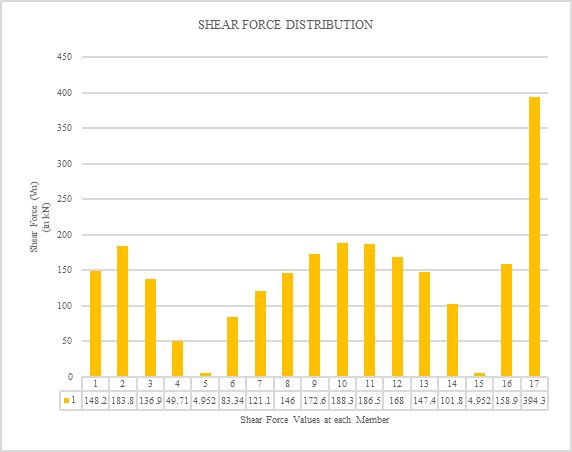
Figure 18. Graphical representation of shear forces at all members of TBM tunnel lining.
The provided results present a comprehensive analysis of the axial force, moment, and shear distributions across different sections of the structure under various loading combinations in STAAD Pro. These findings are crucial for understanding the structural behavior and designing appropriate support systems, particularly in NATM (New Austrian Tunneling Method) and TBM (Tunnel Boring Machine) scenarios.
In NATM conditions, the axial forces vary significantly across sections, with maximum values observed at Section G, indicating the highest load-bearing requirements in that region. The bending moments also exhibit notable variations, with Section G experiencing the highest moments, emphasizing the need for robust structural support. Additionally, shear forces are considerable, particularly in sections such as A and G, suggesting the importance of shear reinforcement.
For TBM conditions, the factored loads, moments, and shears provide essential insights into the extreme loading scenarios the structure may encounter during tunneling operations. These values serve as critical inputs for designing the lining thickness and support systems to ensure structural integrity and safety.
Overall, the results underscore the complex interplay between axial, bending, and shear forces in underground structures and highlight the necessity of comprehensive analyses for designing effective support systems. These findings contribute significantly to the body of knowledge in tunnel engineering and provide valuable insights for optimizing tunnel design and construction methodologies.
This research comprehensively examined the structural behavior of tunnel linings along the Sahar Road cross-passage of Mumbai Metro Line-3, comparing NATM and TBM construction techniques. Using STAAD pro, the study analyzed axial forces, moments, and shear forces to understand their impact on the tunnel's structural integrity. The findings highlighted significant variations in stress resultants across different sections, emphasizing the need for tailored design approaches. Combined stresses were evaluated to ensure long-term performance and safety. A robust design methodology for concrete tunnel linings was developed, incorporating best practices from both construction methods. The study also investigated the effects of shear forces and biaxial moments, considering NATM's final lining as a short column. Additionally, Von Mises stress analysis provided insights into the behavior of Steel Fiber Reinforced Sprayed Concrete Lining (SCL) under complex loads, enhancing the understanding of its structural performance and durability.
[Crossref] [Google Scholar] [PubMed]