

 +44 3308180992
Research Article - International Research Journal of Biotechnology ( 2025) Volume 15, Issue 1
Received: 17-Jul-2024, Manuscript No. irjob-25-142168; Editor assigned: 19-Jul-2024, Pre QC No. irjob-25-142168 (PQ); Reviewed: 02-Aug-2024, QC No. irjob-25-142168; Revised: 16-Jan-2025, Manuscript No. irjob-25-142168 (R); Published: 23-Jan-2025, DOI: 10.14303/2141-5153.2025.69
Cotton (Gossypium hirsutum L.) belongs to Malvaceae circle of relatives that's a regularly pass-pollinated crop. The existing research turned into done the use of thirty hybrids for quantitative and qualitative trends of cotton to estimate the genetic variability gift within genotypes. The material changed into evaluated in randomized block design with 4 replications at some point of Kharif, 2023 at Cotton Studies Station, MB, Farm, Vasantrao Naik Marathwada Krishi Vidyapeeth, Parbhani. The variations among genotypes were giant for all the characters, which discovered massive quantity of variability for all of the tendencies beneath examine. The excessive genotypic and phenotypic coefficient of variant became located for wide variety of bolls in keeping with plant observed through wide variety of monopodia in step with plant, boll weight, wide variety of bolls according to plant, micronaire cost and seed cotton yield according to plant suggesting the presence of big quantity of genetic variability. High heritability coupled with high genetic boost as in step with cent of imply were found for quantity of sympodia in step with plant, boll weight, range of bolls consistent with plant, plant peak, micronaire price and seed cotton yield in step with plant shows the role of additive genes and less environmental affect at the characters and presence of ok heritable version. Thus it can be concluded that selection primarily based at the developments like range of sympodia in line with plant, boll weight and number of bolls in step with plant might be beneficial for similarly crop improvement.
Cotton, Genotypes, Variability, Heritability, Genetic advance
Cotton (Gossypium arboreum L.) is an important reasonably priced crop grown for fibre crop of the world (Aarthi V et al., 2018). It's also a crucial supply of edible oil, protein and cottonseed meal for animals (Ali MA et al., 2007). Cotton belongs to Malvaceae circle of relatives and genus Gossypium, which consists of five allotetraploid and 40-five diploid species amongst them simplest 4 speciesare cultivated global (Baloch MJ, 2004). India has thedistinction of developing all the 4 spinnable lint bearingspecies of Gossypium viz., G. hirsutum, G. barbadense, G.arboreum and G. herbaceum. Among those four cultivatedspecies, desi cotton (G. arboreum L.) is understood for itsresistance to biotic and abiotic stresses production ability,as proven by using the discharge of wide variety of solidtypes and hybrids (Burton GW et al., 1953). Cotton breeders have persevered their efforts to take advantage of the cotton germplasm to broaden excessive yielding cotton types with suitable fibre best (Chandio MA et al., 2003). Peohlman and Selper clarified that the yield contributing and fibre nice traits are heritable in nature (Deshmukh MR et al., 2019). For that reason, quantitative and qualitative developments can be stepped forward by way of utilising appropriate breeding programme by way of growing new cross combinations (Dhamayanathi KP et al., 2010). For this purpose, breeders are interested to have enough knowledge of genetic components including genetic variability, coefficient of variation, heritability and genetic advance to plot the breeding method according to their breeding targets (Dhivya R et al., 2014). Choice is primary tool in crop breeding programme (Erande CS et al., 2014). Presence of genetic variability among the genotypes is fundamental want for practising selection for development in seed cotton yield (Eswari KB et al., 2017). Plant breeders always advocated the genetic variability in breeding populations and considered it as the preliminary requirement to display screen the genetic material for exclusive biotic and abiotic stresses (Fisher RA, 1970). This genetic variability is in addition exploited through using distinctive statistical gear (Johnson HW et al., 1955). Heritability is a powerful statistical tool that enables the plant breeder to estimate the environmental affect for numerous traits in breeding nursery (Manonmani K et al., 2019). It is also a powerful index to determine the quantity of trait this is transferred from dad and mom to off springs (Monisha K et al., 2018). Accordingly, heritability when coupled with genetics advance and genetic variability can be powerful device for plant researcher to select right breeding application (Pandiyan J et al., 2019). Therefore, the existing examine became carried out to assess the genetic variability and heritability for several yield and yield attributing characters in a set of genotypes (Panse VG, 1957). Such data can be useful in formulating effective selection approach for improvement of new genotypes with more suitable yield and its contributing traits (Figure 1).
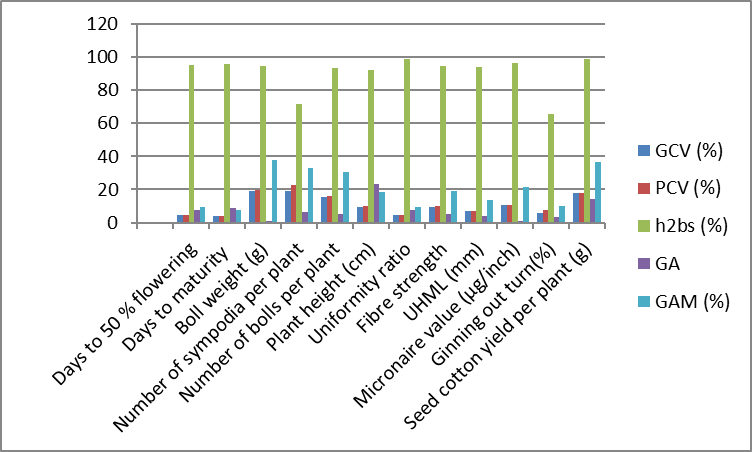
Figure 1. Graphical representation of genetic parameters for sixteen characters in desi cotton (Gossypium arboreum L.).
This test became performed at cotton research station, MB, Farm, Vasantrao Naik Marathwada Krishi Vidyapeeth, Parbhani at some point of Kharif, 2023-24. The experimental plant substances for the prevailing have a look at made from thirty hybrids of cotton (G. hirsutum L.), which were procured at cotton research station, MB Farm, Vasantrao Naik Marathwada Krishi Vidyapeeth, Parbhani (Table 1) (Poehlman JM et al., 1995). These hybrids had been sown in rows of 6 m period with spacing of 60 cm between rows and 30 cm between flora in randomized block design with replications (Praveen SKC et al., 2019). All of the recommended package deal of practices were accompanied to raise wholesome crop. In each replication 5 competitive flowers had been randomly decided on and observations have been recorded on twelve characters (Shivasubramanian S et al., 1973). Observations on fibre nice developments in each replication were recorded through excessive extent instrument in ICC mode at CIRCOT, Nagpur (Shruti SHC et al., 2019). Analysis of variance of the observations recorded on distinctive characters become completed as consistent with the standard procedure counseled by Fisher (Siva Reddy KV et al., 2019). In keeping with Burton and Devane, genotypic and phenotypic coefficients of variation have been anticipated based on the estimates of genotypic and phenotypic variances (Ulloa M, 2006). The genotypic and phenotypic coefficients of version have been categorized as according to the technique advised by using Shiva Subramanian and Menon i.e., 0-10%=Low, 10-20%=slight, Above 20%=high. Heritability in vast experience was calculated as the ratio of genotypic variance to the phenotypic variance and expressed as percentage (Vinodhana KN et al., 2013). The calculated heritability was categorised into three businesses as cautioned with the aid of Johnson et al. i.e., 0-30%=Low, 30-60%=mild, 60%=excessive. Genetic increase was calculated as in line with the components given by Johnson et al., and also labeled as 0-10%=Low, 10-20%=moderate, Above 20%=high. The information recorded at the traits have been analyzed via INDOSTAT software (Table 1).
| Sr. No. | Hybrids | Sr. No. | Hybrids | Sr. No. | Hybrids | Sr. No. | Hybrids | Sr. No. | Hybrids |
| 1 | PA 785 x PA 810 | 7 | PA 873 x PA 08 | 13 | PA 833 x AKA 8 | 19 | PA 904 x PA 402 | 25 | PA 809 x JLA 505 |
| 2 | PA 785 x PA 08 | 8 | PA 873 x AKA 8 | 14 | PA 833 x PA 402 | 20 | PA 904 x JLA 505 | 26 | CNA 1032 x PA 810 |
| 3 | PA 785 x AKA 8 | 9 | PA 873 x PA 402 | 15 | PA 833 x JLA 505 | 21 | PA 809 x PA 810 | 27 | CNA 1032 x PA 08 |
| 4 | PA 785 x PA 402 | 10 | PA 873 x JLA 505 | 16 | PA 904 x PA 810 | 22 | PA 809 x PA 08 | 28 | CNA 1032 x AKA 8 |
| 5 | PA 785 x JLA 505 | 11 | PA 833 x PA 810 | 17 | PA 904 x PA 08 | 23 | PA 809 x AKA 8 | 29 | CNA 1032 x PA 402 |
| 6 | PA 873 x PA 810 | 12 | PA 833 x PA 08 | 18 | PA 904 x AKA 8 | 24 | PA 809 x PA 402 | 30 | CNA 1032 x JLA 505 |
Table 1. List of hybrids.
The analysis of variance for the sixteen seed cotton yield and its attributing traits revealed that the mean sum of squares due to genotypes were highly significant for all the traits studied. Therefore, adequate variability was present for yield and yield contributing traits in the material studied (Table 2).
| Source of variation | d.f. | Mean sum of squares | |||||||||||
| Days to 50% flowering | Days to maturity | Boll weight (g) | Number of sympodia per plant | Number of bolls per plant | Plant height (cm) | Uniformity ratio | Fibre strength | UHML (mm) | Micronaire value (µg/inch) | Ginning outturn | Seed cotton yield per plant (g) | ||
| 1 | 2 | 3 | 4 | 5 | 6 | 7 | 8 | 9 | 10 | 11 | 12 | ||
| Replications | 1 | 0.81 | 1.66 | 0.02 | 6.01 | 0.15 | 8.82 | 0.02 | 0.01 | 0.04 | 0.01 | 0.39 | 0.006 |
| Treatments | 29 | 28.10** | 38.95** | 0.53** | 30.03** | 15.02** | 292.63** | 28.85** | 13.87** | 7.79** | 0.58** | 10.36** | 100.10** |
| Error | 29 | 0.67 | 0.77 | 0.01 | 4.91 | 0.53 | 11.44 | 0.19 | 0.39 | 0.23 | 0.01 | 2.14 | 0.62 |
Table 2. Mean sum of squares values for yield contributing and fibre quality characters in cotton.
Possibility of improving economic characters through selection in crop depends largely on the extent of genetic variability present in the population. Genotypic and phenotypic coefficient of variation gives the idea about the extent of variability present in genetic population, whereas heritability is useful in predicting the role of transmission factors in phenotypes expression and ultimately selection of elite genotypes from the segregating population. Heritability along with genetic advance favours the fixation of genetic factors for any particular trait. The outcomes related to general mean, range and genetic parameters of variation, broad sense heritability (h2) and genetic advance as per cent mean for all the characters presented in Table 3. The estimates of Genotypic and phenotypic coefficient of variation were observed high for boll weight (18.93% and 19.45%), number of sympodia per plant (19.01% and 22.42%), number of bolls per plant (15.39% and 15.94%) and seed cotton yield per plant (17.94% and 18.05%), which is due to presence of huge amount of variability amongst all the genotypes studied for the traits. Similarity between both the values depicts the least influence of environment on these characters emphasizing a greater scope of improvement through selection. The results are in concordance with the findings of Erande et al., Aarthi et al., Pandiyan et al., Praveen et al. and Siva Reddy et al. The measured values of genotypic and phenotypic coefficient of variation for plant height (9.45% and 9.82%), fibre strength (9.52% and 9.80%) and micronaire (10.68% and 10.89%) were moderate which suggest the presence of moderate amount of variability which can be utilized through selection for efficient breeding programme. The results are in accordence with the findings of Dhivya et al., Aarthi et al., Pandiyan et al. and Shruti et al. The genotypic and phenotypic coefficient of variation measured for the traits like days to flowering (4.66% and 4.78%), days to maturity (3.69% and 3.77%), uniformity ratio (4.71% and 4.75%), upper half mean length (6.91% and 7.12%) and ginning out turn (5.90% and 7.28%) were low indicating that there is less variability among the genotypes studied. Similar results were also observed by Vinodhana et al., Erande et al., Aarthi et al., Pandiyan et al., Shruti et al., and Siva Reddy et al. Whereas low genotypic coefficient of variation (3.69%) and phenotypic coefficient of variation (3.77%) recorded for days to maturity. Which indicates that there is influence of environment. Similar kind of result was reported by Vinodhana et al (Table 3).
| Sr. No. | Character | Mean | Range | Coefficient of Variation | h2bs (%) | GA | GAM (%) | ||
| Min | Max | GCV (%) | PCV (%) | ||||||
| 1 | Days to 50% flowering | 51.65 | 47 | 58 | 4.66 | 4.78 | 95.28 | 7.44 | 9.38 |
| 2 | Days to maturity | 118.2 | 112 | 128.5 | 3.69 | 3.77 | 96.12 | 8.82 | 7.46 |
| 3 | Boll weight (g) | 2.68 | 1.5 | 3.37 | 18.93 | 19.48 | 94.44 | 1.01 | 37.91 |
| 4 | Number of sympodia per plant | 18.65 | 12.5 | 26.5 | 19.01 | 22.42 | 71.89 | 6.19 | 33.19 |
| 5 | Number of bolls per plant | 17.48 | 12.5 | 27 | 15.39 | 15.94 | 93.19 | 5.35 | 30.61 |
| 6 | Plant height (cm) | 125.45 | 114 | 141 | 9.45 | 9.82 | 92.48 | 23.48 | 18.72 |
| 7 | Uniformity ratio | 80.21 | 80.65 | 84.1 | 4.72 | 4.75 | 98.7 | 7.74 | 9.65 |
| 8 | Fibre strength | 27.26 | 27.15 | 29.55 | 9.52 | 9.8 | 94.48 | 5.19 | 19.07 |
| 9 | UHML (mm) | 28.13 | 28.3 | 29.8 | 6.91 | 7.12 | 94.18 | 3.89 | 13.82 |
| 10 | Micronaire value (µg/inch) | 5.01 | 3.7 | 5.75 | 10.68 | 10.89 | 96.25 | 1.08 | 21.58 |
| 11 | Ginning out turn (%) | 34.35 | 31.36 | 36.65 | 5.9 | 7.28 | 65.68 | 3.38 | 9.85 |
| 12 | Seed cotton yield per plant (g) | 39.3 | 17.4 | 29.6 | 17.94 | 18.05 | 98.77 | 14.44 | 36.74 |
Table 3. Genetic parameters of variation for seed cotton yield and its contributing traits in cotton.
The higher estimates of heritability were recorded for days to 50% flowering (95.28%), days to maturity (96.12%), boll weight (94.44%), number of bolls per plant (93.19%), plant height (92.48%), uniformity ratio (98.70%), fibre strength (94.48%), upper half mean length (94.18%), micronaire value (96.25%) and seed cotton yield per plant (98.77%). These finding are in agreement with the earlier findings of Erande et al., Eswari et al., Aarthi et al., Deshmukh et al., Manonmani et al., Pandiyan et al., Praveen et al., Shruti et al. and Siva Reddy et al. This suggested the greater effectiveness of selection and improvement to be expected for these characters in future breeding programmes as the genetic variance is mostly due to the additive gene action. Moderate heritability was observed for number of sympodia per plant (71.89%) and ginning out turn (65.68%). Similar kinds of results were reported by Dhivya et al., Erande et al. and Monisha et al.
Heritability approximations at the side of genetic improve could be more worthwhile in looking forward to development of seed cotton yield underneath phenotypic choice than heritability estimates by myself as advised with the aid of Johnson et al. If heritability is especially due to non-additive gene impact, the expected genetic strengthen might be low, and if there's additive gene impact, a high genetic increase may be anticipated. On this observe, excessive heritability coupled with excessive genetic improve as percent of suggest become determined for boll weight (37.91%), range of sympodia consistent with plant (33.19%), number of bolls per plant (30.61%) and seed cotton yield consistent with plant (36.74%). It shows that most likely the heritability is due to additive gene effects and choice will be useful by means of making use of the fixable genes for improvement. Comparable results had been also reported with the aid of Aarthi et al., Monisha et al., Pandiyan et al. and Praveen et al.
Excessive heritability coupled with mild genetic enhance as percentage of imply became determined for plant peak (18.72%), fibre electricity (19.07%), higher 1/2 imply duration (13.82%) and micronaire fee (21.58%). Similar effects were located with the aid of Monisha et al., and slight heritability observed with mild significance of genetic develop as consistent with cent of suggest became discovered for ginning out flip (9.55%). Those effects are in agreement with the findings of Dhivya et al. and Praveen et al. The received consequences imply the operation of both additive and non-additive gene movement and desired effects won't be received by means of easy choice. Excessive heritability coupled with low genetic strengthen as per cent of mean recorded for days to 50% flowering (9.38%) and days to adulthood (7.46%) which indicates the presence of non-additive gene movement which offers a constrained scope of improvement. The excessive heritability is being exhibited due to beneficial influence of environment in preference to genotype indicating the opportunity of development in these trends through heterosis breeding in preference to easy choice. Similar outcomes had been suggested by means of Erande et al., Eswari et al. and Manonmani et al. The heritability is being unveiled because of favourable influence of surroundings rather than genotype indicating the possibility of improvement of this trait via heterosis breeding, in preference to easy selection. Comparable findings were located by Erande et al., Monisha et al. and Praveen et al.
The genotypic coefficients of variant for all the characters studied had been lesser than the phenotypic coefficients of version indicating the effect of surroundings.
The range of GCV and PCV have been recorded higher for extensive type of monopodia in keeping with plant accompanied through variety of bolls consistent with plant, lint yield in keeping with plant and seed cotton yield in step with plant indicating the effect of measurable amount of variability. Whereas, low GCV and PCV had been resulted by means of days to flowering followed via days to boll bursting, ginning in keeping with cent, seed index, oil content material, 2.5% span period, Micronaire and fibre power. Accordingly, suggesting the selection in suited manner might play a better position in crop improvement. Excessive heritability coupled with excessive genetic strengthen as in step with cent of suggest were determined for plant peak, wide variety of monopodia consistent with plant, quantity of sympodia in line with plant and quantity of bolls in line with plant. High heritability coupled with moderate genetic advance recorded for boll weight and fibre power. The tendencies which showcase excessive heritability coupled with high genetic advance indicating the function of additive genes and choice based on those tendencies like plant height, number of monopodia according to plant, wide variety of sympodia in keeping with plant and number of bolls in line with plant might be beneficial for further crop improvement.
The authors would like to thank incharge, cotton research station, MB, Farm, Vasantrao Naik Marathwada Krishi Vidyapeeth, Parbhani for providing research facilities and material required for this experiment.
The authors declare no potential conflict of interest.