
Research Article - Journal of Medicine and Medical Sciences ( 2026) Volume 17, Issue 1
Received: 01-Jun-2026, Manuscript No. jmms-24-140208; Editor assigned: 04-Jun-2026, Pre QC No. jmms-24-140208 (PQ); Reviewed: 18-Jun-2026, QC No. jmms-24-140208; Revised: 23-Jul-2026, Manuscript No. jmms-24-140208 (R); Published: 30-Jul-2026, DOI: 10.14303/2141-9477.2026.144
Introduction: Violence against women constitutes a major public health and criminal justice issue, particularly in low- and middle-income countries. Understanding the contributing factors through a multidimensional approach that integrates individual, relational, community, and societal levels is essential for guiding prevention and response strategies.
Methods: This was a retrospective, descriptive, and analytical study conducted from January 1, 2021, to December 31, 2025, at the Forensic Medicine Department of the Regional Hospital of Conakry. The study included 3,427 victims of violence. Data were collected from forensic medical and judicial records. The variables examined included socio-demographic characteristics, individual factors related to alleged perpetrators, relational, community, and societal factors, as well as forensic and judicial data. Descriptive and bivariate analyses were performed, with Odds Ratios (ORs) and Chi-square (χ²) tests calculated. Statistical significance was set at p<0.05.
Results: Victims were predominantly young (≤ 25 years: 81.62%), single (54.10%), and poorly educated (49.31% with no formal schooling). Alleged perpetrators were mainly young men (71.48%), often unemployed (38.09%), and frequently had a history of violence (72.83%). Violence occurred predominantly within intimate relationships (56.38%), with high frequencies of marital conflict (80.95%), jealousy (58.91%), and economic dependency (92.56%). Incidents mainly took place in public spaces (41.67%) and during daytime hours (54.04%), with a predominance in suburban areas (67.81%). Societal factors were characterized by a high level of social acceptance of violence (81.70%) and a family history of violence (90.95%). Physical violence was the most common form (54.55%), frequently involving injuries to the upper limbs (41.40%) and the use of blunt objects (45.67%). Most victims sought medical consultation between 24 and 72 hours after the incident (47.21%), and 99.21% had filed a complaint. Significant associations were found between the studied factors and the occurrence of violence, particularly alcohol use (OR=1.95), drug use (OR=1.43), jealousy (OR=2.06), and economic dependency (OR=155.0) (p<0.001).
Conclusion: Violence against women in Conakry results from a complex interaction of individual, relational, community, and societal factors. The findings highlight the central role of intimate relationships, economic inequalities, and social norms in the occurrence of violence. A comprehensive approach integrating social prevention, women’s economic empowerment, and the strengthening of forensic and judicial systems appears essential for reducing this phenomenon.
Violence against women; Intimate partner violence; Relational factors; Societal factors; Forensic medicine; Conakry
Violence against women constitutes a major global public health, human rights, and criminal justice concern. According to the World Health Organization (WHO), nearly one in three women worldwide has experienced physical or sexual violence during her lifetime, most often within the context of an intimate relationship (WHO, 2002). Such violence has serious and multidimensional consequences, including physical, psychological, social, and economic harm (Garcia-Moreno et al., 2005).
Beyond its prevalence, understanding the factors contributing to violence against women is a central issue for prevention and response efforts. The ecological model proposed by the World Health Organization highlights the interaction of multiple determinants operating at the individual, relational, community, and societal levels (WHO, 2002). This model conceptualizes violence as the result of a complex combination of factors rather than as isolated events.
At the individual level, several studies have identified factors associated with violent behavior, including young age, male sex, low educational attainment, socioeconomic disadvantage, and the use of psychoactive substances (Jewkes, 2002; Abramsky et al., 2011). At the relational level, violence occurs predominantly within intimate relationships, where factors such as marital conflict, jealousy, and economic dependence reinforce patterns of domination and control (Heise, 1998).
Community-level factors also play an important role. Urban environments characterized by high population density, socioeconomic inequalities, and rapid urbanization are often associated with increased interpersonal violence (WHO, 2021). The location and timing of assaults can help identify specific patterns, particularly distinguishing domestic violence from violence occurring in public spaces.
At the societal level, social and cultural norms that tolerate or normalize violence, as well as practices such as early marriage, contribute to the perpetuation of violence against women (World Bank, 2011). A family history of violence is also a significant factor, reflecting the intergenerational transmission of violent behaviors (UN Women, 2015).
From a forensic perspective, the assessment of injuries, mechanisms of trauma, and Temporary Total Incapacity for Work (TTIW) not only helps determine the severity of violence but also provides objective evidence regarding the circumstances of the assault and supports judicial proceedings (Widom, 1989). However, delayed consultation, which is frequently observed among victims, may compromise the quality of forensic findings and hinder appropriate care and support (Saukko, 2023).
In Guinea, despite the magnitude of violence against women, scientific data remain limited, particularly studies adopting a comprehensive approach to contributory factors. Existing research is scarce and often fragmented, preventing a thorough understanding of the multidimensional determinants of such violence.
In this context, the present study aims to analyze the factors contributing to violence against women in Conakry through an integrated approach encompassing individual, relational, community, and societal dimensions. It also seeks to identify the main factors associated with violence in order to contribute to the development of prevention strategies tailored to the Guinean context.
Study design and setting
This was a retrospective, descriptive, and analytical study conducted over a five-year period, from January 1, 2021, to December 31, 2025. The study was carried out at the Department of Forensic Medicine of the Regional Hospital of Conakry, a referral center for the medico-legal management of victims of violence in Guinea, operating upon requests from judicial authorities and healthcare services.
Study population
The study population consisted of all victims of violence who were received and examined during the study period. All complete records containing exploitable socio-demographic, forensic, and judicial information were included. Identified alleged perpetrators documented in the records were also subject to specific analysis.
Inclusion and exclusion criteria
Inclusion criteria:
• Any victim of violence who underwent a forensic medical examination
• Records containing complete and usable data
• Cases recorded during the study period
Exclusion criteria:
• Incomplete or unusable records
• Cases not involving interpersonal violence
Data sources and collection
Data were collected from multiple sources, including:
• Forensic consultation registers
• Medico-legal certificates
• Expert reports
• Hospital records
• Judicial reports and police records.
A standardized data collection form was used to ensure data consistency and quality. Cross-checking of information from different sources was performed to minimize data-entry errors.
Study variables
Socio-demographic variables: Age, marital status, educational level, occupation, and municipality of residence.
Individual variables (Alleged perpetrators): Estimated age, sex, educational level, employment status, substance use, and history of violent behavior.
Relational variables: Relationship with the perpetrator, prior marital conflict, jealousy or suspicion of infidelity, and economic dependence.
Community variables: Location of the assault, time of occurrence, and type of neighborhood.
Societal variables: Early marriage, social acceptance of violence, and family history of violence. These societal variables were based on victims’ statements and the socio-cultural context.
Forensic variables: Type of violence (physical, sexual, psychological), injury location, injury mechanism, and Temporary Total Incapacity for Work (TTIW). Some variables, particularly types of violence and injury locations, could occur simultaneously in the same victim, resulting in frequencies exceeding the total sample size.
Judicial variables: Filing of a complaint and identification of the perpetrator.
Statistical analysis
Data were entered and analyzed using statistical software (SPSS, R, or Epi Info).
Descriptive analysis: Frequencies and percentages were calculated for categorical variables and presented in tables.
Bivariate analysis: Associations between explanatory variables and the occurrence of violence were assessed using:
• Chi-square (χ²) tests for comparison of proportions.
• Odds Ratios (ORs) with 95% confidence intervals (95% CIs).
Statistical significance was set at p<0.05.
The association between the location and time of occurrence of assaults was analyzed using the Chi-square test.
Methodological considerations
Some analyses, particularly the relationship between the location and timing of assaults, were based on analytical reconstruction of data in the absence of originally cross-tabulated information, which may have introduced interpretation bias. Likewise, certain variables, especially societal factors, were based on victims’ self-reports and may therefore be subject to reporting and subjectivity bias.
Ethical considerations
The study was conducted in accordance with the ethical principles of medical research, including:
• Anonymization of data
• Confidentiality of information
• Use of data exclusively for scientific purposes.
The study was carried out within the framework of medico-legal activities authorized by the health and judicial authorities.
Victims were predominantly young, with the largest age groups being 19-25 years (41.38%) and ≤ 18 years (40.24%). Most victims were single (54.10%) and had a low level of education, with nearly half having received no formal schooling (49.31%). Regarding occupational status, victims were mainly unemployed (40.08%) or engaged in the informal sector (29.94%). Geographical distribution showed a strong concentration in peri-urban areas, particularly Tombolia (28.80%) and Sanoyah (21.24%) (Table 1).
Among the 3,427 victims examined, 164 (4.79%) were pregnant, while the vast majority, 3,263 (95.21%), were not (Figure 1).
Among pregnant women, most pregnancies were in the second trimester (76.22%), followed by the first trimester (14.02%) and the third trimester (9.76%) (Figure 1).
| Variable | Category | Frequency (n) | Percentage (%) |
| Age (years) | ≤ 18 | 1,379 | 40.24 |
| 19-25 | 1,418 | 41.38 | |
| 26-35 | 453 | 13.22 | |
| 36-45 | 100 | 2.92 | |
| >45 | 77 | 2.25 | |
| Marital status | Single | 1,854 | 54.1 |
| Married | 1,250 | 36.48 | |
| Divorced | 218 | 6.36 | |
| Widowed | 105 | 3.06 | |
| Educational level | No formal education | 1,690 | 49.31 |
| Primary education | 1,173 | 34.23 | |
| Secondary education | 532 | 15.52 | |
| Higher education | 32 | 0.93 | |
| Occupation | Unemployed | 1,408 | 40.08 |
| Student | 840 | 24.51 | |
| Informal worker/Laborer | 1,026 | 29.94 | |
| Civil servant | 32 | 0.93 | |
| Trader/Merchant | 153 | 4.46 | |
| Municipality of residence | Kaloum | 0 | 0 |
| Dixinn | 0 | 0 | |
| Matam | 0 | 0 | |
| Ratoma | 14 | 0.41 | |
| Matoto | 280 | 8.17 | |
| Lambanyi | 210 | 6.13 | |
| Gbessia | 139 | 4.06 | |
| Sonfonia | 482 | 14.06 | |
| Tombolia | 987 | 28.8 | |
| Kagbelen | 127 | 3.71 | |
| Sanoyah | 728 | 21.24 | |
| Maneah | 152 | 4.43 | |
| Neighboring prefectures | 308 | 8.99 |
Table 1. Socio-demographic characteristics of victims (N=3,427).
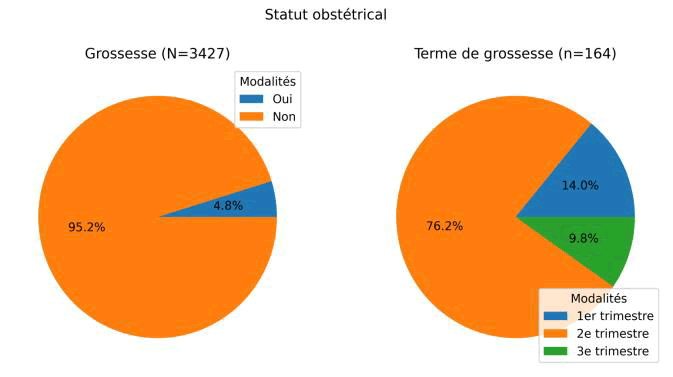
Figure 1. Obstetric status.
The alleged perpetrators were predominantly young adults (20-30 years: 40.80%), male (71.48%), and had low levels of education, with most having either primary education (47.91%) or no formal schooling (27.14%). They were mainly unemployed (38.09%) or manual workers (33.06%).
Psychoactive substance use was reported in 47.60% of cases, and a history of violent behavior was documented in 72.83% of cases (Table 2).
Violence was predominantly perpetrated by a current intimate partner (56.38%), with a high frequency of marital conflicts (80.95%) and economic dependence (92.56%) among victims (Table 3).
Assaults occurred mainly in public spaces (41.67%) and in the marital home (32.27%). They took place predominantly during daytime hours (54.04%) and were highly concentrated in suburban areas (67.81%), reflecting an urban pattern of violence (Table 4).
Societal factors were characterized by a high level of social acceptance of violence (81.70%) and a high prevalence of family histories of violence (90.95%), while early marriage was reported among 44.38% of victims (Table 5).
Physical violence was the most common form of abuse (54.55%), followed by psychological violence (25.19%) and sexual violence (20.26%). Multiple forms of violence could occur simultaneously in the same victim.
Injuries mainly involved the upper limbs (41.40%), suggesting defensive mechanisms. Blunt objects were the most frequent injury-causing mechanism (45.67%). Most victims had a temporary total incapacity for work (TTIW) of ≤ 20 days (76.01%) (Table 6).
Most victims sought consultation between 24 and 72 hours after the assault (47.21%), while 31.22% consulted more than 72 hours after the incident (Figure 2).
| Variable | Category | Frequency (n) | Percentage (%) |
| Estimated age (based on victim statements or judicial records) | 20-30 years | 1,502 | 40.8 |
| 31-40 years | 1,135 | 30.83 | |
| 41-50 years | 842 | 22.87 | |
| >50 years | 198 | 5.38 | |
| Sex | Male | 2,631 | 71.48 |
| Female | 1,050 | 28.52 | |
| Educational level | No formal education | 980 | 27.14 |
| Primary education | 1,792 | 47.91 | |
| Secondary education | 903 | 24.77 | |
| Higher education | 6 | 0.18 | |
| Employment status | Unemployed | 1,402 | 38.09 |
| Laborer/Manual worker | 1,217 | 33.06 | |
| Student | 725 | 19.7 | |
| Trader/Merchant | 337 | 9.16 | |
| Substance use | Yes | 1,752 | 47.6 |
| No | 1,195 | 32.46 | |
| Unknown | 734 | 19.94 | |
| History of violence | Yes | 2,681 | 72.83 |
| No | 831 | 22.58 | |
| Unknown | 169 | 4.59 |
Table 2. Characteristics of alleged perpetrators.
| Variable | Category | Frequency (n) | Percentage (%) |
| Relationship with the perpetrator | Current intimate partner | 1,932 | 56.38 |
| Former intimate partner | 842 | 24.57 | |
| Family member | 341 | 9.95 | |
| Acquaintance | 303 | 8.84 | |
| Stranger | 9 | 0.26 | |
| Previous marital conflict | Yes | 2,774 | 80.95 |
| No | 653 | 19.05 | |
| Jealousy/Suspicion of infidelity | Yes | 2,019 | 58.91 |
| No | 1,408 | 41.09 | |
| Economic dependence | Yes | 3,172 | 92.56 |
| No | 255 | 7.44 |
Table 3. Relational factors associated with violence against women (N=3,427).
| Variable | Category | Frequency (n) | Percentage (%) |
| Location of the assault | Marital home | 1,106 | 32.27 |
| Victim’s home | 138 | 4.03 | |
| Street/Public space | 1,428 | 41.67 | |
| Isolated area | 494 | 14.41 | |
| Recreational venue | 261 | 7.62 | |
| Time of the assault | 00:00-06:00 | 635 | 18.53 |
| 07:00-15:00 | 1,852 | 54.04 | |
| 16:00-23:00 | 940 | 27.43 | |
| Neighborhood type | City center | 643 | 18.76 |
| Suburban area | 2,324 | 67.81 | |
| Peri-urban area | 460 | 13.42 |
Table 4. Community-related factors associated with violence against women (N=3,427).
| Variable | Category | Frequency (n) | Percentage (%) |
| Early marriage | Yes | 1,521 | 44.38 |
| No | 1,906 | 55.62 | |
| Social acceptance of violence | Yes | 2,800 | 81.7 |
| No | 627 | 18.3 | |
| Family history of violence | Yes | 3,117 | 90.95 |
| No | 310 | 9.05 |
Table 5. Societal factors associated with violence against women (N=3,427).
| Variable | Category | Frequency (n) | Percentage (%) |
| Type of violence* | Physical | 2,499 | 54.55 |
| Sexual | 928 | 20.26 | |
| Psychological | 1,154 | 25.19 | |
| Total | 4,581 | 100 | |
| Injury location† | Head/Neck | 704 | 18.9 |
| Upper limbs | 1,542 | 41.4 | |
| Lower limbs | 580 | 15.57 | |
| Chest/Abdomen | 629 | 16.89 | |
| Genital region | 270 | 7.25 | |
| Total | 3,725 | 100 | |
| Injury mechanism | Punches/Kicks | 1,307 | 38.13 |
| Sharp weapon | 472 | 13.77 | |
| Blunt object | 1,565 | 45.67 | |
| Thermal agent | 83 | 2.42 | |
| Total | 3,427 | 100 | |
| Temporary Total Incapacity for Work (TTIW) | ≤ 20 days | 2,605 | 76.01 |
| >20 days | 822 | 23.99 | |
| Total | 3,427 | 100 |
Table 6. Forensic characteristics of violence against women.
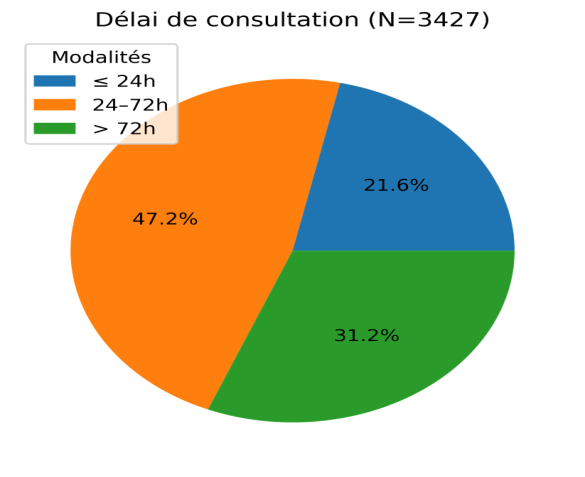
Figure 2. Consultation period (N=3 427).
The vast majority of victims had filed a complaint (99.21%), and the alleged perpetrator was identified in 92.76% of cases (Table 7).
Bivariate analysis showed that alcohol consumption, drug use, jealousy, and economic dependence were significantly associated with violence (p<0.001). However, these findings should be interpreted with caution due to limitations related to the definition of the dependent variable (Table 8).
A statistically significant association was observed between the location and time of occurrence of assaults (χ² ≈ 450; df=6; p<0.001). Nevertheless, these results were based on an analytical reconstruction of the data and should therefore be interpreted cautiously (Table 9).
| Variable | Category | Frequency (n) | Percentage (%) |
| Complaint filed | Yes | 3,400 | 99.21 |
| No | 27 | 0.79 | |
| Perpetrator identified | Yes | 3,179 | 92.76 |
| No | 248 | 7.24 |
Table 7. Judicial characteristics of violence against women (N=3,427).
|
Factor |
Violence (Yes) |
Violence (No) |
OR (95% CI) |
p-value |
|
Alcohol use |
1,752 |
1,195 |
1.95 (1.74-2.19) |
<0.001 |
|
Drug use |
1,300 |
1,026 |
1.43 (1.27-1.61) |
<0.001 |
|
Jealousy |
2,019 |
1,408 |
2.06 (1.85-2.30) |
<0.001 |
|
Economic dependence |
3,172 |
255 |
155.0 (130-184) |
<0.001 |
Table 8. Bivariate analysis of factors associated with violence against women.
| Location of assault | 00:00-06:00 | 07:00-15:00 | 16:00-23:00 | Total |
| Home* | 350 | 500 | 394 | 1,244 |
| Street/Public space | 150 | 950 | 328 | 1,428 |
| Isolated area | 110 | 180 | 204 | 494 |
| Recreational venue | 25 | 222 | 14 | 261 |
| Total | 635 | 1,852 | 940 | 3,427 |
| Note: *Home includes assaults occurring in the marital home and the victim’s residence | ||||
Table 9. Distribution of assaults according to location and time of occurrence (N=3,427).
Statistical analysis: χ² ≈ 450; df=6; p<0.001.
Note: A statistically significant association was observed between the location and time of occurrence of assaults. However, these cross-tabulated data were reconstructed analytically from aggregated information and should therefore be interpreted with caution.
In this study, violence against women emerged as a multifactorial phenomenon that fully aligns with the World Health Organization’s ecological model, which postulates the interaction of individual, relational, community, and societal factors in the genesis of violence (Adams et al., 2016; Muluneh et al., 2021). Our findings highlight a convergence of socio demographic, economic, behavioral, and cultural determinants, reflecting the structural and systemic nature of violence.
Individual factors: Youth, low education, and socioeconomic vulnerability
The predominance of young women (≤ 25 years) observed in our study is consistent with global estimates indicating that violence often begins early in women’s relational and reproductive lives (Adams et al., 2016). Similarly, studies conducted in sub-Saharan Africa have shown that adolescents and young adults are at increased risk of violence due to limited decision making autonomy and power imbalances within intimate relationships (Yakubovich et al., 2018).
Furthermore, the low educational level observed among both victims and alleged perpetrators represents a major determinant. Capaldi et al., demonstrated that socio-educational vulnerabilities are strongly associated with intimate partner violence (Capaldi et al., 2012), while Yakubovich et al., in a meta-analysis, confirmed the protective role of education (Uthman et al., 2011). In West Africa, particularly in Nigeria, lack of formal education has been significantly associated with increased exposure to violence (Pichon et al., 2020).
In addition, the socioeconomic precariousness observed in our study constitutes an important aggravating factor. Evidence from sub-Saharan Africa indicates that poverty and economic dependence reduce women’s bargaining power and increase their vulnerability to violence (Yakubovich et al., 2018).
Relational factors: Central role of intimate partners and conflict dynamics
Our findings confirm the central role of intimate partners, with more than 80% of violent incidents involving a current or former partner. This observation is consistent with global evidence indicating that most violence against women occurs within intimate relationships (Muluneh et al., 2021).
Moreover, the high prevalence of marital conflicts and jealousy observed in our study highlights the importance of relational determinants. Pichon et al., identified jealousy as a major trigger of violence in intimate relationships (Kyegombe et al., 2022).
Likewise, qualitative studies conducted in East Africa have emphasized the central role of male jealousy in dynamics of control and intimate partner violence (Gebrezgi et al., 2017).
Economic dependence, which affected the majority of victims, also emerged as a key structural factor. The WHO emphasizes that the lack of financial autonomy limits women’s ability to leave abusive relationships and contributes to the persistence of violence (Adams et al., 2016).
Behavioral factors: The role of alcohol and drug use
Alcohol and drug use by alleged perpetrators were significantly associated with violence. This finding is well documented in the literature. Greene et al. reported that partner alcohol consumption is a major risk factor for violence in sub-Saharan Africa (Gebrezgi et al., 2017). Similarly, recent analyses using Demographic and Health Survey (DHS) data from East Africa confirmed this association (Gebrezgi et al., 2017). The WHO also identifies harmful alcohol use as a major risk factor, acting through disinhibition and the escalation of interpersonal conflicts (Adams et al., 2016).
Intergenerational violence factors: Transmission of violence
The high prevalence of previous exposure to violence observed in our study suggests the existence of an intergenerational transmission process. Theoretical models indicate that early exposure to violence increases the likelihood of reproducing violent behaviors in adulthood (Capaldi et al., 2012; Uthman et al., 2011). In African settings, this transmission is reinforced by social norms that tolerate violence and by the lack of effective preventive mechanisms (Yakubovich et al., 2018).
Societal factors: Cultural norms and early marriage
Our results revealed a high level of social acceptance of violence and a substantial prevalence of early marriage. The WHO identifies social norms that tolerate intimate partner violence as a major structural determinant (Adams et al., 2016). In a study conducted in West Africa, Uthman et al. demonstrated that both individual and community acceptance of violence are strongly associated with its occurrence (Pichon et al., 2020).
Furthermore, early marriage exposes young women to unequal unions and increased dependence, thereby heightening their risk of violence. A study conducted in Ethiopia confirmed this association, particularly during pregnancy (Gebrezgi et al., 2017).
Community factors: Urbanization and spaces of violence
The spatial distribution of violence in our study showed a predominance of urban and peri-urban areas.
Research from sub-Saharan Africa indicates that rapid urbanization and poor living conditions contribute to increased violence (Yakubovich et al., 2018). These environments are often characterized by high population density, weak social cohesion, and 9 Int. Res. J. Medci. Medical. Sci REFERENCES ISSN: 2141-9477 economic inequalities, creating conditions conducive to violence.
Forensic and public health implications
Finally, the predominance of physical violence and the pattern of injuries observed are consistent with mechanisms of direct assault and defensive reactions. However, the coexistence of psychological and sexual violence underscores the complexity of the phenomenon. The WHO emphasizes that the consequences of violence are multidimensional, encompassing physical, psychological, reproductive, and social impacts (Adams et al., 2016).
This study demonstrates that violence against women in Conakry is a complex and multidimensional phenomenon deeply rooted in individual, relational, community, and societal determinants. Analysis of the 3,427 cases confirms the central role of intimate relationships in the occurrence of violence, within a context characterized by the youth of victims, low educational attainment, and socioeconomic vulnerability.
The findings particularly highlight the importance of relational factors, including marital conflicts, jealousy, and economic dependence, which appear to be major drivers of violence. These factors are compounded by behavioral determinants such as alcohol and psychoactive substance use, as well as intergenerational influences reflecting the transmission of violence within family structures.
Moreover, the significant influence of societal factors, particularly the social acceptance of violence and the persistence of practices such as early marriage, underscores the role of cultural norms in perpetuating violence against women. The spatial distribution of assaults, with a predominance in urban and peri-urban areas, further reflects the impact of social and economic dynamics associated with urbanization.
From a forensic perspective, the predominance of physical violence and the high frequency of upper-limb injuries suggest mechanisms of direct assault and self-defense. In addition, delays in seeking medical consultation highlight the need to improve early access to healthcare services and forensic examinations.
These findings confirm that violence against women cannot be understood as isolated incidents but rather as the product of interconnected vulnerabilities operating across multiple levels.
Consequently, effective prevention requires a comprehensive, integrated, and multisectoral approach based on: (i) Strengthening women’s economic and educational empowerment; (ii) Transforming social norms that tolerate violence; (iii) Preventing alcohol and psychoactive substance abuse; (iv) Improving the early detection of violence within intimate relationships; and (v) Strengthening forensic, healthcare, and judicial response systems.
[Crossref] [Google Scholar] [PubMed]
[Crossref] [Google Scholar] [PubMed]
[Crossref] [Google Scholar] [PubMed]
[Crossref] [Google Scholar] [PubMed]
[Crossref] [Google Scholar] [PubMed]
[Crossref] [Google Scholar] [PubMed]
[Crossref] [Google Scholar] [PubMed]
[Crossref] [Google Scholar] [PubMed]
[Crossref] [Google Scholar] [PubMed]
[Crossref] [Google Scholar] [PubMed]
[Crossref] [Google Scholar] [PubMed]