
Research Article - International Research Journal of Plant Science ( 2025) Volume 16, Issue 1
Received: 30-Sep-2024, Manuscript No. IRJPS-24-149187; Editor assigned: 02-Oct-2024, Pre QC No. IRJPS-24-149187 (PQ); Reviewed: 16-Oct-2024, QC No. IRJPS-24-149187; Revised: 27-Feb-2025, Manuscript No. IRJPS-24-149187 (R); Published: 04-Feb-2025
Tef (Eragrostis tef (Zucc.) Trotter) is a significant food and cash crop. In Ethiopia, it is vital to food security. However, the country's overall output performance is dismal. Between September 2019 and September 2020, researchers in East Belesa district, Central Gondar zone, and Amhara National Regional State assessed yield performance and farmer preference for enhanced Tef varieties. Researchers in East Belesa district, Central Gondar zone, and Amhara National Regional State analyzed yield performance and farmer preferenc es for improved Tef varieties between 2019 and 2020. 212 small household farmers were selected from six major kebeles via observations, questionnaires, focus group discussions, and semi semi-structured interviews, and both descriptive and inferential data was a nalyzed using Minitab 18. The confidence level, Chi-square tests, and one one-way ANOVA were set to 95%. P<0.05 was considered statistically significant. The majority of respondents (77.4%) favored the Cross Cross-37 improved tef variety; whereas the Boset improved tef variety was only grown in the Achikan and Guhala Guhala-01 Kebeles. According to ANOVA data, smallholder Cross Cross-37 and Boset varieties had mean productivity of 31.20 q/ha and 9.60 q/ha in 2010 EC, respectively. Cross Cross-37 had the same mean productivity (32.80 q/ ha) in 2011 and 2012 EC, while Boset had the same mean productivity (9.60 q/ha) for three years running. More research, with a larger sample size, area coverage, and a supporting molecular approach, is needed to understand the limitations of tef production in the studied area. This study found that Cross Cross-37 produced well and chose a superior tef variety in the study region region.
Eragrostis tef, Improved variety, Yield performance, Farmers’ preference, East Belesa district
Tef (Eragrostis tef (Zucc.) Trotter) is a major staple crop in Ethiopia (Fufa B et al., 2011). Tef is considered a less risky crop compared to other cereals due to its remarkable resilience to adverse weather conditions. Tef is an annual grass that grows in the warm season and pollinates itself (Assefa K et al., 2011). Most people use its grain to make enjera, Ethiopia's main national meal, which is a spongy flatbread (Hopman E et al., 2008). Tef is also valued for its fine straw, which may be used as animal feed or in construction when combined with mud. Tef contains 11% protein, 80% complex carbohydrate content, and 3% fat. Tef grain has more minerals than other cereal grains like maize, wheat, sorghum, and millets (Degefa I, 2019).
Tef grain has 180, 0.8, 7.6, 184, 9.2, 429, 3.6, 427, 12, and 4.4 mg of calcium, copper, iron, magnesium, manganese, phosphorus, zinc, potassium, sodium, and selenium, respectively, per 100 grams (Firew GA, 2010).
Tef grain contains more vitamins than other cereals, including 0.39 mg of thiamine, 0.27 mg of riboflavin, and 3.4 mg of niacin (Singh B, 2006). Tef is becoming increasingly popular in Europe and North America as a health food for gluten-intolerant persons due to its nutritional balance (Dale JW et al., 2011).
Tef is the most challenging crop to cultivate (Setotaw F, 2011). Tef cultivation requires a maximum of six ploughings. Ploughing eliminates weeds, breaks up and softens the soil, and increases its water-holding capacity (Minten B et al., 2016). Tef farms with insufficient water before sowing will have a lower yield (Minten B et al., 2016). Tef crops are commonly disturbed by animals before sowing. Grass and other plant detritus are also removed from the space between rows (Tekalign S et al., 2020). If tef fields are not trampled, the small tef seeds will be hidden beneath the soil, allowing weeds to take over the crop two or three days after planting (Kasa L et al., 2015). Trampling waterlogged fields is not recommended since it will bury the soil beneath the surface water (Bakala F et al., 2018).
A scientific research effort in Ethiopia began in the late 1950’s with the goal of improving tef productivity through genetic improvement and appropriate cultural practices (Abebaw D et al., 2010). However, financing has been limited, and only approximately 20 better cultivars have been produced. Tef is indigenous to Ethiopia, and the only source of genetic variation for effective breeding is landrace collections and cross-pollination of selected parents from the landraces, with few or no opportunities for introducing and acquiring breeding materials and other germplasm from other countries. In contrast, relying on cultivars with a constant genetic background may expose crops to harmful diseases, insects, and environmental changes. To establish successful and efficient breeding techniques, data on the magnitude and pattern of phenotypic and genetic variation among released types should be collected on a regular basis.
Despite increased tef demand, no survey of improved tef output or farmer preferences for improved tef varieties has been done in the area. Additionally, the East Belesa district is a tef-growing center. As a result, this study focused on tef performance and farmer preferences for improved tef varieties to increase tef productivity in the study area.
Description of the study area
The Central Gondar Zone includes East Belesa. East Belesa district is roughly 173 kilometers north of Bahir Dar, the capital of the Amhara National Regional State, and 87 kilometers south of East Gondar, the seat of the Central Gondar Zone. The altitude of East Belesa district ranges from 1,500 to 2,000 meters above sea level. The district is located approximately between 5°44'10” to 6°12'38” N latitude and 38°45'10” to 39°12'37” E longitude. The average temperature in the district typically ranges from 10°C to 27°C. The annual rainfall in East Belesa district averages between 750 mm and 850 mm. The district experiences varying levels of humidity based on its agroecological zones. It includes three main zones: Dega (11%): Humid, Weina Dega (29%): Sub-humid, Kola (60%): Dry arid. The predominant soil types in East Belesa District include:
Nitosols: Red basaltic soils that are fertile but may have low water retention capacity.
Orthic acrisols: These soils are typically red-brown and black-brown, found on sloping terrains, providing good agricultural utilization under natural vegetation. Overall, the combination of altitude, favorable temperatures, adequate rainfall, and suitable soil types makes East Belesa District a viable region for cultivating tef and other crops.
Soil type South Gondar Zone borders this district on the south, West Belessa Zone on the west, Wegera on the northwest, Jan Amora on the north, and Wag Hemra Zone on the east (Figure 1). The district covers an area of 181,675.5 acres and is divided into 30 administrative Kebele.
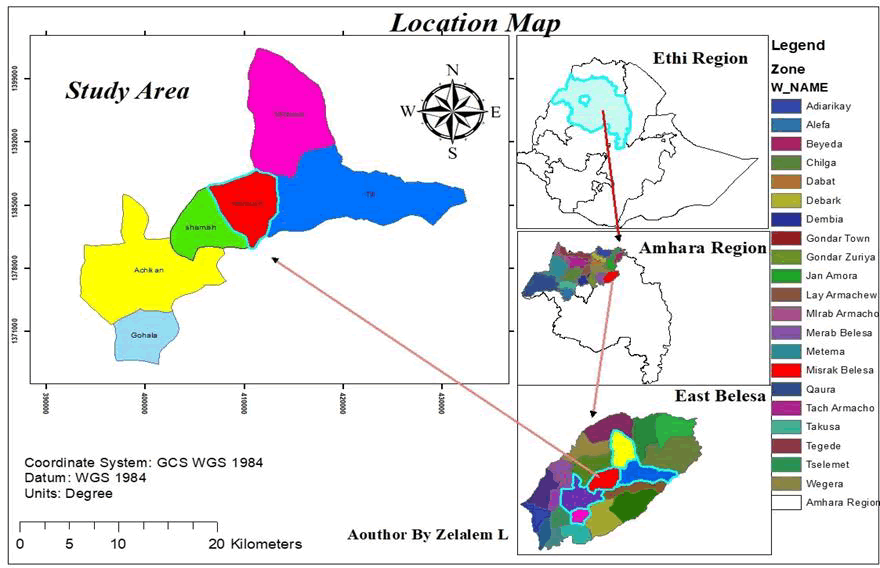
Figure 1. Maps of the study area.
Research design
The study, conducted in six East Belesa district kebeles from 2019 to 2020, used qualitative and quantitative data to assess tef productivity and farmer preferences. Interviews, focus group discussions, and observations were utilized to collect quantitative and qualitative data, while the results of the house survey were analyzed with descriptive statistics.
Study population
The population of East Belesa district (also known as Misraq Belessa) is approximately 97,838 according to the 2007 national census conducted by the Central Statistical Agency of Ethiopia. This population comprises about 50,587 men and 47,251 women, with 13,057 individuals (or 13.4%) residing in urban areas. The majority of the population practices Ethiopian Orthodox Christianity, while a smaller percentage identifies as Muslim.
East Belesa district's economy is heavily reliant on agriculture, with tef production being central to both food security and income generation for the majority of households. East Belesa district's primary rain-fed crops include tef, sorghum, wheat, barley, and beans. Tef is a staple food and income source, while sorghum is droughtresistant and adaptable. Wheat contributes to food security and local diets. Beans provide protein and enhance soil fertility. These diverse crops ensure food security and economic stability for farming communities. Some of the most popular livestock include cattle, goats, sheep, donkeys, and poultry.
Sample size and sampling techniques
East Belesa District consists of 30 kebeles, which are local administrative units that facilitate agricultural activities and community development. The study used a stratified random sampling strategy, dividing kebeles into three agroecologies (Weina Dega, Dega, and Kola). Six kebeles were chosen from each stratum, and a simple random sampling strategy was used to identify kebeles that shared the same agro-ecology. In the fourth stage, a random selection procedure was used to select sample households from six kebeles, with a representative sample size of 212, based on 10% of the total population.
Data collection instruments and procedures
The study, conducted in six Kebeles in EBD from 2019 to 2020, aimed to gather information on performance and farmer preferences for enhanced tef varieties. Data was collected through observation, questionnaires, interviews, and focus group discussions, with the researcher encouraging farmers to express themselves.
Data analysis techniques
The study analyzed raw data from household questionnaires using descriptive statistics, Minitab version 18, one-way ANOVA, and Chi-square testing. The confidence level was 95%, and the data was gathered using semi-structured interviews and qualitative reports.
Improved tef varieties grown in the study area
Commonly grown improved tef varieties: The research area grew Cross-37 and Boset improved tef varieties, with Cross-37 being widely used in Kebeles and Boset only in Achikan and Guhala-01 Kebeles. Most respondents preferred Cross-37 (77.4%), with only 22.6% mentioning boset (Table 1). The Chi-square values of generally farmed varieties (χ2=11.290) and preferred improved tef varieties (χ2=137.306) were statistically significant (p<0.05), showing a significant difference between commonly grown and preferred improved tef varieties among the research kebeles.
| Kebeles | |||||||
| Commonly grown improved tef varieties | SS n (%) | TL n (%) | HM n (%) | MC n (%) | AC n (%) | GH n (%) | Total n (%) |
| Cross-37 | 19 (100%) | 41 (100%) | 37 (100%) | 49 (100%) | 10 (26.3) | 8 (28.6) | 164 (77.4) |
| Boset | NP | NP | NP | NP | 28 (73.7) | 20 (71.4) | 48 (22.6) |
| X2=137.306 | p=0.00 | df= 5 | |||||
| Note: NP=Not Produced, SS=Shamsh, TL=Tily, HM= Hamusit-01, MC=Michwa, AC=Achikan, GH=Guhala-01 | |||||||
Table 1. Commonly grown tef varieties.
Productivity of improved tef varieties
The study found that Cross-37 and Boset were improved tef varieties in the study area. Cross-37 productivity was higher in Michiwa Kebele, while in Achikan and Guhala-01, it was lower. Boset productivity was higher in Achikan and Guhala01, with Achikan Kebele having higher output. A one-way ANOVA revealed significant differences in productivity between the two varieties (Table 2).
| Improved tef varieties (q/ha) | Mean and SD | Kebeles | ||||||||
| SS | TL | HM | MC | AC | GH | Total | F-Value | P-Value | ||
| In 2010 E.C | ||||||||||
| Cross-37 | Mean | 3.6 | 8.2 | 7.4 | 9.8 | 1.6 | 1.6 | 5.37 | 3.37 | 0.013 |
| SD | 3.78 | 6.57 | 6.5 | 9.58 | 2.19 | 2.61 | 5.21 | |||
| Boset | Mean | NP | NP | NP | NP | 5.6 | 4 | 4.8 | 3.35 | 0.013 |
| SD | NP | NP | NP | NP | 7.16 | 4.3 | 5.73 | |||
| In 2011 E.C | ||||||||||
| Cross-37 | Mean | 3.8 | 8.2 | 7.4 | 9.8 | 2 | 1.6 | 5.47 | 3.4 | 0.012 |
| SD | 5.4 | 7.43 | 6.77 | 9.15 | 1.87 | 2.19 | 5.47 | |||
| Boset | Mean | NP | NP | NP | NP | 5.6 | 4 | 4.8 | 3.91 | 0.006 |
| SD | NP | NP | NP | NP | 5.55 | 3.74 | 4.65 | |||
| In 2012 E.C | ||||||||||
| Cross-37 | Mean | 3.8 | 8.2 | 7.4 | 9.8 | 2 | 1.6 | 5.47 | 3.11 | 0.018 |
| SD | 3.63 | 8.93 | 7.33 | 8.58 | 2.83 | 2.61 | 5.65 | |||
| Boset | Mean | NP | NP | NP | NP | 5.6 | 4 | 4.8 | 3.5 | 0.01 |
| SD | NP | NP | NP | NP | 5.55 | 4.3 | 4.93 | |||
| Note: SD=Standard Deviation, NP=Not Produced, SS=Shamsh, TL=Tily, HM=Hamusit-01, MC=Michwa, AC=Achikan, GH=Guhala-01, q/ha=quintal per hectare | ||||||||||
Table 2. Productivity of improved tef varieties.
The study found that Cross-37's total mean productivity in 2010 EC was higher than Boset's, possibly due to factors such as agro-ecological variances, altitude differences, farmer preferences, and climatic changes. Cross-37 had higher mean productivity at the Kebele level than Michiwa Kebele, while Boset's productivity was lower in Achikan and Guhala-01 Kebeles. However, Cross-37 had equal sum mean productivity in 2011 and 2012 EC, indicating stable production performance. The study also found that Cross37's mean productivity was higher in 2011 and 2012 EC due to adequate rainfall, drought tolerance, and increased knowledge of improved tef varieties. In Kebele level, Cross37's mean productivity was stable in all Kebeles except Achikan and Shamsh Kebeles.
Sources of improved tef variety seeds
The majority of responders (57.6%) said the Agricultural Institute provided them with tef seeds. Other respondents bought theirs from the market (23.6%), followed by their own seeds (18.8%) (Table 3).
| Sources of improved tef variety seeds | Kebeles | ||||||
| SS | TL | HM | MC | AC | GH | Total | |
| n (%) | n (%) | n (%) | n (%) | n (%) | n (%) | n (%) | |
| From market | 6 (31.5) | 8 (19.5) | 12 (32.4) | 13 (26.6) | 4 (10.6) | 7 (25.0) | 50 (23.6) |
| Research institute | 0 | 0 | 0 | 0 | 0 | 0 | 0 |
| Agricultural institute | 9 (47.4) | 27 (65.9) | 17 (45.9) | 25 (51.0) | 28 (73.7) | 16 (57.1) | 122 (57.6) |
| NGO | 0 | 0 | 0 | 0 | 0 | 0 | 0 |
| Yourself | 4 (21.0) | 6 (14.6) | 8(21.6) | 11 (22.4) | 6 (15.8) | 5 (17.9) | 40 (18.8) |
| Note: SS=Shamsh, TL=Tily, HM=Hamusit-01, MC=Michwa, AC=Achikan, GH=Guhala-01 | |||||||
Table 3. Sources of improved tef variety seeds.
As this research result indicated that the majority of the respondents stated that they obtained improved tef variety seeds from the agricultural institute. As respondents explained that, East Belesa agricultural office supplies better improved tef variety of seeds for agro-ecology and climatic conditions of the study area. Other respondents obtained seeds from the market. As they realized that they bought tef varieties from farmers that grown improved tef varieties last year. Lastly, other respondents were used their own improved tef variety seeds. This means, if they obtained improved tef variety seeds in the past years and cultivated, they could use that seed for planting in the new season. In the same study, the main tef seed sources were neighbors; own savings from the previous year; farmer’s union or cooperatives; local traders; extension agent; local seed producers and research institutes.
Interviews and focus group discussion
Interviews: On boosting tef variety production, interviews were conducted with four experienced farmers from each kebele. Everyone in the study had at least six years of experience growing improved tef varieties. Improved tef varieties in the research region include Cross-37 and Boset. For their environment, farmers in Shamsh, Tily, Hamusit-01, and Michwa Kebeles favored the Cross-37 tef variety. Farmers valued this variety for a variety of reasons, including excellent grain yields, timely seed production, and drought resilience. It was reported by farmers in Achikan and Guhala-01. Because of their kebeles' Dega weather, the Boset tef variety was picked for their environment.
The use of fertilizers in the production of tef was explained by interviewees. Farmers said they utilized inorganic fertilizers since organic fertilizer preparation was difficult due to a lack of water and drought conditions. They also stated that fertilizer costs were considerable, and that purchasing and applying fertilizers for tef cultivation was challenging.
Focus Group Discussion (FGD)
In FGD, DAs discovered Cross-37 and Boset were improved tef varieties grown in the research area. According to sources, improved tef types are few in number, with only two available because no other improved tef variety was acceptable for their climatic conditions. Cross-37 started growing in 1999 EC, whereas Boset started growing in 2004
EC, according to DAs. Cross-37 outperformed Boset in terms of output and recommended tef types in the research region for three years in a row (2010, 2011, and 2012 EC). Because, according to informants, Cross-37 produces higher yields, seeds at the appropriate time, and is more drought resistant than Boset. In dega Kebeles, boset was mostly grown (Achikan and Guhala-01). Farmers can anticipate receiving 18 quintals of tef per hectare, according to the researchers.
Farmers acquired improved tef varieties from the Agricultural Office, according to DAs. Farmers were also given fertilizers to boost the yield of tef types, according to them. DAs also discovered that some farmers bought better tef variety seeds from the market, while others grew their own.
Observation
Farmers used a variety of production strategies, as well as improved tef varieties from the agricultural office. According to the researcher, farmers in the study area were also planting tef in broadcast patterns.
Demographic characteristics of respondents in the study area
In Ethiopia, 80.9% of men and 19.1%of women participate in crop cultivation. Age has a considerable impact on household agricultural production like the study conducted by Abebaw et al. Adult farmers are more likely to accept new technologies than older farmers. In Borecha, South West Ethiopia, 27.3% of respondents were illiterate, 55.5% had primary education, and 17.2% had secondary education. The majority of the respondents in the same study were married. The average family size in the sample was smaller than the national average (5.3%). Small family size may not be an option to overcome a manpower deficit in tef agriculture, especially for labor-intensive methods.
Farm characteristics of respondents in the study area
The majority of respondents had total land sizes ranging from 4.1-6.0 ha, according to the results of this poll. The bulk of respondents, on the other hand, said their tefproducing farm land was between 1.5 and 4 hundredths of a hectare. There is a positive relationship between experience and productivity since more experienced could learn production from their previous experiences more quickly.
Food and cash crops in the study area
The total mean productivity of smallholder tef producers in 2010 E.C was higher than the other crops. Tef is a potential food and cash crop in which farmers can produce in large scale for income generation. But Masho was produced for only cash in all Kebeles. In 2011 E.C, the mean productivity of tef was also higher in Michiwa Kebele than the rest Kebeles and yields of sorghum and masho (local) were equal. Different results may due to agro-ecology differences, farmer's way of cultivation and climate differences. In 2012 E.C, tef and sorghum had equal mean productivity in Michiwa Kebele and they had higher mean productivity than the rest Kebeles. Differences in productivity may due to agro-ecology differences, farmer's way of cultivation and climatic differences.
Production system of farmers and economic importance of tef
Tef is the most important crop in terms of cultivation area and production value in Ethiopia. As respondents reported that, tef is the major crop for source of food and cash for respondents in the study area followed by sorghum. Tef can also be used as an animal feed and as building material.
Tef varieties grown in the study area
Although the Cross-37 improved tef variety was widely planted in the research region, Boset was only grown in the Achikan and Guhala-01 Kebeles. This is attributable to variances in agro ecology, farmer preferences, and climate in the areas analyzed. A criterion for selecting improved tef varieties in the study area included yield performance, disease tolerance, drought tolerance, market value, and maturity at the proper time. This could be due to changes in agroecology and climate between the study Kebeles. Market value and maturity were the least important factors for selecting new tef types in Shamsh and Achikan Kebels. Farmers in the study Kebeles used yield performance, maturity, and market value as some of the factors for selecting better modified tef varieties.
Productivity of improved tef varieties in the study area
Boset was produced only in Achikan and Guhala-01 Kebeles. At kebele level, the mean productivity of Cross-37 in 2010 E.C was higher in Michiwa Kebeles than that of Boset. This may be due to agro-ecological differences, farmer's preferences, and climatic differences in the study area. From these research results, we can conclude that Cross-37 was produced on a small-scale in Achitan and Guhalahau Kebels. Cross-37 and Boset improved tef varieties had equal-sum mean productivity in the study area in 2010, 2011, and 2012 E.C. This may be due to the same production practices in each season. The mean productivity of Cross-37 in three consecutive years was higher in Michwa Kebele than in the other kebeles. According to the results of preferential ranking on productivity performance, Coss was found to be the more productive variety, while Boset came in as the least productive.
Genetic and environmental factors, as well as farmer preference criteria, can influence the cultivation of tef. To boost tef production in the study area, it is best to consider the qualities of high yield with adaptability to various biotic and abiotic challenges, as well as the farmer's preference. Tef is the most important grain farmed as a food and cash crop on a large scale in the study area. Farmers selected these improved tef varieties based on yield, maturation at the right time, market value, drought tolerance, and disease resistance. In the study, the total mean production performance of the Cross-37 improved tef variety remained constant between 2011 and 2012. The average means performance of the study area across the seasons did not differ, indicating the consistency of this variety across seasons. In 2011, however, worldwide mean production was greater than in 2010. According to researchers Cross-37 is the best improved tef type in the study region. Boset's total mean productivity in these two kebeles was lower than Cross-37's in all other types throughout the course of these three years. More research with larger sample size and area coverage is needed to gain a better understanding of the restrictions to tef production and productivity in the study area. Farmers' participation and molecular breeding may be part of the study.
[Crossref] [Google Scholar] [PubMed]
[Crossref]
Citation: Zelalem Linger (2025). Assessment of Yield Performance and Farmers' Preference for Improved Tef (Eragrostis tef (Zucc.) Trotter) Varieties in East Belesa District, Northwest Ethiopia. IRJPS. 16:03.